
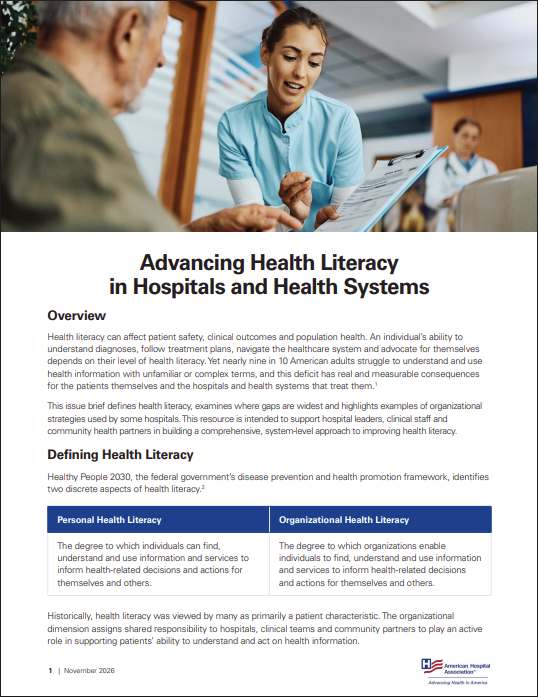
Health literacy can affect patient safety, clinical outcomes and population health. An individual’s ability to understand diagnoses, follow treatment plans, navigate the healthcare system, and advocate for themselves depends on their level of health literacy. Yet nearly nine in 10 American adults struggle to understand and use health information with unfamiliar or complex terms, and this deficit has real and measurable consequences for the patients themselves and the hospitals and health systems that treat them.
This issue brief defines health literacy, examines where gaps are widest and highlights examples of organizational strategies used by some hospitals. This resource is intended to support hospital leaders, clinical staff and community health partners in building a comprehensive, system-level approach to improving health literacy
By the Numbers
9 in 10
American adults struggle to understand and use health information that contains unfamiliar, complex or technical terms.
75%
higher risk of mortality among patients with low health literacy.
24%
higher risk of mortality among patients with intermediate health literacy levels.
Defining Health Literacy
Healthy People 2030, the federal government’s disease prevention and health promotion framework, identifies two aspects of health literacy:
Personal Health Literacy
The degree to which individuals can find, understand and use information and services to inform health-related decisions and actions for themselves and others.
Organizational Health Literacy
The degree to which organizations enable individuals to find, understand and use information and services to inform health-related decisions and actions for themselves and others.
Historically, health literacy was viewed as primarily a patient characteristic. The organizational dimension assigns shared responsibility to hospitals, clinical teams and community partners to actively support patients' ability to understand and act on health information.
Who Is Most Affected?
Low health literacy is more prevalent in certain populations, making it a key driver of health disparities. Populations with elevated rates of limited health literacy include:
- Non-native English speakers and patients with limited English proficiency
- Adults with lower educational attainment or income
- Adults over 65
- Individuals with mental health or substance use conditions
- Patients with chronic conditions who navigate complex, long-term treatment regimens
Leading Practices in Health Literacy
Health literacy interventions work best when embedded in routine care and paired with training for all patient-facing roles. These approaches, drawn from research and health system practice, can produce measurable results.
Plain Language Communication
Use accessible language instead of clinical jargon in discharge instructions, consent forms and patient education, aiming for a sixth-grade reading level or below.
Teach-back Method
Ask patients to explain in their own words what they will do after leaving care. This evidence-based approach improves understanding and adherence and reduces callbacks and cancelled appointments.
Health Literacy Universal Precautions
Assume every patient benefits from clearer communication rather than screening only for "low literacy." This reduces stigma and simplifies implementation.
Caregiver Health Literacy Support
Loma Linda University Children's Hospital in California screened caregivers' health literacy and tailored discharge instructions, cutting 30-day readmissions from 12.3% to 10.5% and raising caregiver satisfaction from 80% to 100% in one year.
Patient and Family Advisory Councils
Patient and Family Advisory Councils (PFACs) offer a direct channel for building communication materials patients can use. PFACs can support hospitals by testing language, format and delivery directly with patients.
Building a Health Literate Organization
Health literacy is an organizational commitment that reaches every department, patient encounter and communication touchpoint. This framework identifies six priority areas, with example actions and indicators to track progress.
Priority Areas
Example Actions: Plain language materials; teach-back training; universal precautions approach
Measurement Indicators: Readmission rates; HCAHPS scores; health literacy screening tool adoption rates
Example Actions: Plain language discharge instructions; follow-up call protocols
Measurement Indicators: 30-day readmission rate; ER return visits; HCAHPS Discharge Information
Example Actions: Health literacy training in onboarding; annual competency refreshers
Measurement Indicators: Training completion rates; observed communication audits
Example Actions: Plain language patient portals; multilingual app support; digital navigation assistance
Measurement Indicators: Portal activation rates; digital health literacy assessments
Example Actions: Certified interpreter availability; translated materials at accessible literacy levels
Measurement Indicators: Interpreter utilization rates; LEP patient experience scores
Example Actions: Health literacy champion program; executive accountability; community partnership
Measurement Indicators: Strategic plan inclusion; budget allocation; community health needs assessment linkage
The Opportunity Ahead
Health literacy is a shared responsibility among patients, providers and the organizations that structure how care is delivered. Hospitals making the most progress have built health literacy into how they communicate and measure outcomes. The AHA supports this work through resources, convening and peer learning across the field.
Additional Resources
Podcast | The First Chapter: Literacy and Bonding in the NICU
Is your organization advancing health literacy? Share your work to be considered for a future case study, blog or podcast.