

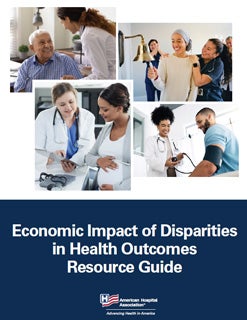
Resource Guide: Economic Impact of Disparities in Health Outcomes
Health disparities not only impact health outcomes — they drive avoidable costs across health care systems, reduce workforce productivity and lead to rising care complexity.
To address this challenge, the AHA has developed the Economic Impact of Disparities in Health Outcomes Resource Guide, a new resource designed to bring the financial consideration of health disparities into focus.
This guide addresses a critical gap by helping leaders understand and quantify the economic burden of disparities. It provides practical methods to identify and assess the financial impact of health disparities, along with data-driven approaches to implement interventions that both improve outcomes and reduce costs.
With this guide, you can:
- Build a compelling business case by linking disparities to measurable financial impact on organizations and the communities they serve for addressing disparities, grounded in their measurable financial impact on organizations and the communities they serve
- Strengthen organizational infrastructure to identify, measure and track disparities alongside cost and revenue implications
- Drive data-informed action by designing targeted, high-impact interventions that improve outcomes and reduce avoidable costs
- Sustain progress with continuous measurement, evaluation and alignment with quality and financial goals
Designed for hospital and health system leaders and decision-makers, this resource combines real-world case examples, actionable guidance and a structured discussion framework. It enables organizations to assess the economic impact of health disparities and utilize data-driven strategies that enhance affordability, improve outcomes and support long-term financial resilience.
Why it Matters
Health disparities are a major driver of cost, utilization, and financial strain across the healthcare system. Differences in outcomes across populations lead to higher rates of preventable disease, avoidable utilization, and less favorable health outcomes. For hospitals and health systems, these disparities translate into increased emergency department visits, preventable admissions and readmissions, longer lengths of stay, and rising care complexity.
The impact extends beyond care delivery, contributing to lost workforce productivity, reduced labor participation, and higher uncompensated care. As margins tighten, addressing disparities becomes both a clinical priority and a financial imperative. Organizations that invest in data-driven strategies to improve access, prevention, and care coordination can reduce avoidable costs while strengthening outcomes, workforce stability, and community well-being.
The economic impact of health disparities can be understood across three interconnected areas:
- The overall societal burden.
- Excess health care expenditures borne by individuals and organizations.
- The downstream impacts on the workforce and economy.