

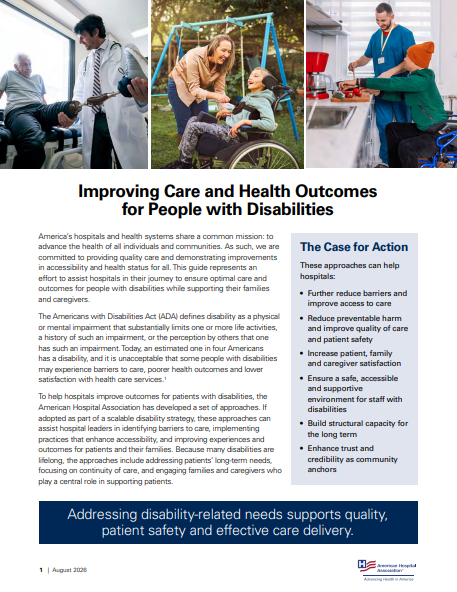
America's hospitals and health systems share a common mission: to advance the health of all individuals and communities. An estimated one in four Americans lives with a disability, and too often, people with disabilities face barriers to care, experience poorer health outcomes and report lower satisfaction with the care they receive.
The AHA is committed to supporting hospitals and health systems as they work to close these gaps through disability-competent clinical care, workforce training, community partnerships and stronger data infrastructure. This work is guided by a set of recommendations developed to help hospital leaders identify barriers to care, implement practices that enhance accessibility, and improve experiences and outcomes for patients with disabilities and their families.
Guiding Principles for Disability-inclusive Care

Person-centered Care
Recognize the unique needs and preferences of individuals
Comprehensive Accessibility
Integrate accessibility into facilities, technology and workflows

Sustainable Systems
Move from one-time fixes to long-term structural solutions
Health Disparities Snapshot
1 in 4
Adults age 18-44 with disabilities lack a usual source of care
6.5x
More likely for youth with disabilities to have diagnosed anxiety
4x
More likely for adults with disabilities to report depression
Suggested Approaches
Following are approaches hospitals and health systems may choose to explore based on their respective priorities, resources and community needs. These are not intended as requirements or a comprehensive checklist, but rather options to support locally tailored disability strategies.
Clinical Care Delivery
Enhance healthcare accessibility and quality through disability-focused workforce training, seamless care coordination, accessible technology and strengthened transition and homebased care models.
Community Partnerships
Partner with community-based disability organizations to develop bidirectional referral pathways and outreach tools.
Data and Infrastructure
Improve care quality through standardized disability data collection, integrating data into care planning and performance measurement and proactive insurance coverage support.
Workforce and Culture
Support workforce readiness for serving patients with complex or disabilityspecific needs by incorporating practices into onboarding, ongoing education and leadership development.
Get Involved
Participate in Listening Sessions
Listening sessions are designed to gather insights from hospital leaders, clinicians, workforce professionals, data teams, caregivers, community partners and individuals living with a disability. These sessions are intended to advance understanding of disability to reduce disparities in health outcomes and highlight hospitals and health systems’ efforts to improve disability competence and accessible care.
Discussion topics include:
- Accessibility barriers
- Staff training
- Care coordination across settings
- Digital tools and telehealth
- And many more
Let’s work together
Have a question, a resource to share or a program worth highlighting? We are always looking for opportunities to collaborate, exchange strategies and learn from what’s working across the field.