

Rural maternal care is not delivered by one clinician, hospital or organization alone. It is supported by an interconnected ecosystem of people, services and resources working together to care for women and families throughout pregnancy, delivery and postpartum.
To better understand how this ecosystem works in rural communities, the AHA engaged hospital and health system leaders from across the country through interviews, site visits and focus groups. Their experiences offer insights into the strategies, partnerships and approaches helping sustain and strengthen maternal care locally.
Keeping Care Close to Home: A Rural Maternal Health Toolkit offers practical strategies from the field that hospitals and health systems can use to expand, strengthen and sustain maternal care in their communities.
Throughout the toolkit, hospitals and health systems can:
- Explore strategies for strengthening different parts of the rural maternal care ecosystem.
- Learn from the field through examples of how rural hospitals and health systems are putting these approaches into practice.
- Consider opportunities locally through discussion questions designed for hospital and health system leaders.
- Identify connections in workforce, technology, community partnerships and regional systems of care.
Explore Strategies from the Field
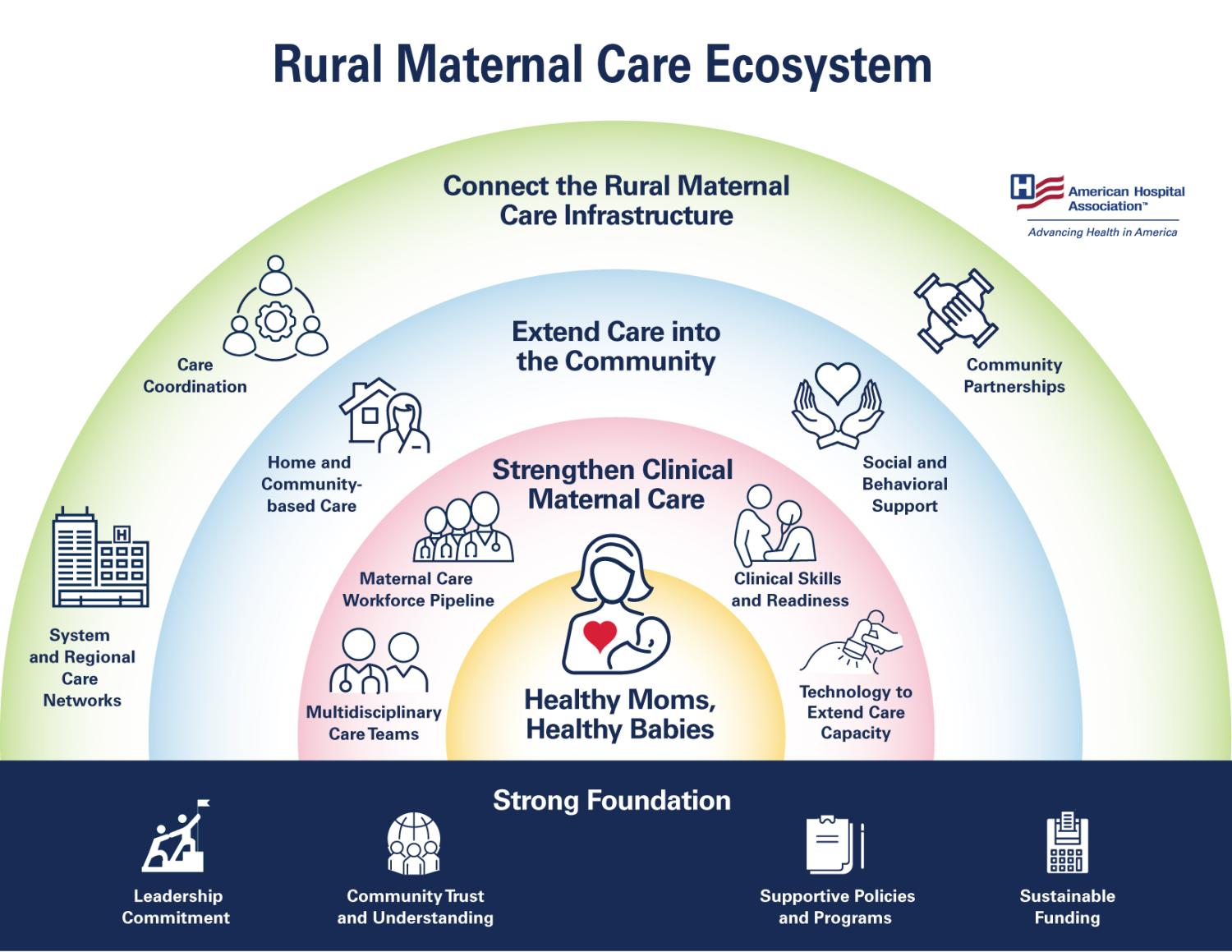
The toolkit organizes strategies across four interconnected areas of the rural maternal care ecosystem. Together, they illustrate how hospitals and health systems can build on local strengths while connecting care teams and patients to additional expertise, services and resources.
See each area of the ecosystem to discover strategies, examples from the field and considerations for hospital and health system leaders.
Building a Strong Foundation
Sustaining rural maternal care begins with a strong foundation. Hospitals can help create the conditions for long-term success by establishing:
- Leadership commitment
- Community trust and understanding
- Supportive policies and programs
- Sustainable funding
Extending Care Into the Community
Maternal health is shaped by what happens before, between and after clinical visits. Hospitals are working with community partners to help patients remain connected to care throughout pregnancy and postpartum by:
- Bringing care closer to home
- Supporting social and behavioral needs
Strengthening Clinical Maternal Care
Rural maternal care depends on having a skilled, supported and prepared team. Hospitals are developing new approaches for:
- Building and sustaining the workforce pipeline
- Strengthening multidisciplinary maternal care teams
- Improving clinical readiness
- Expanding care capacity through technology
Connect the Rural Maternal Care Infrastructure
No rural hospital should have to sustain maternal care alone. Strong relationships among rural hospitals, referral centers, specialists, emergency medical services and community providers can create a broader system of support around patients and local care teams. Explore how hospitals are:
- Coordinating care across the continuum
- Strengthening community partnerships
- Building connected care networks
Supported by the Commonwealth Fund, a national, private foundation based in New York City that supports independent research on healthcare issues and distributes grants to improve healthcare practice and policy. The views presented here are those of the authors and not necessarily those of the Commonwealth Fund, its directors, officers or staff.