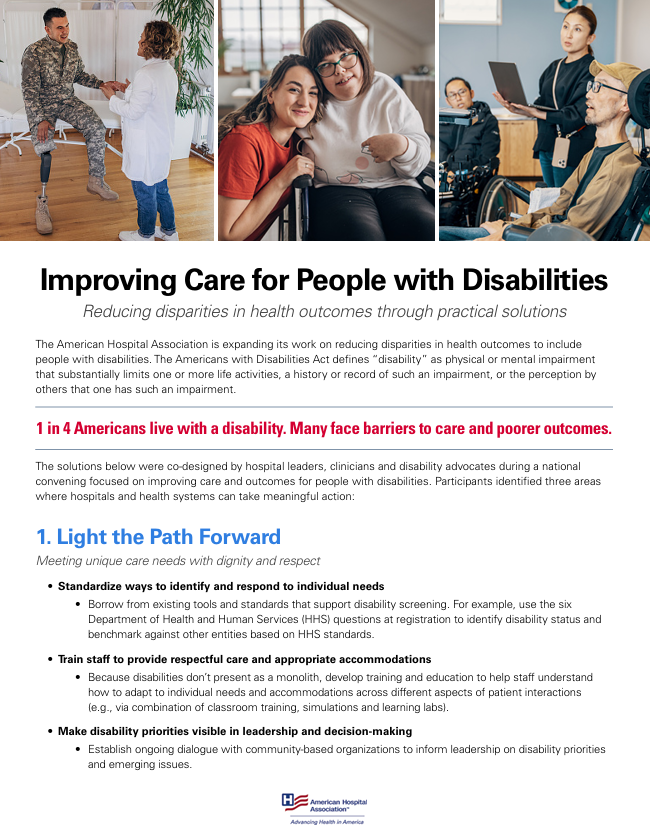
Improving Care for People with Disabilities
Reducing disparities in health outcomes through practical solutions
The American Hospital Association is expanding its work on reducing disparities in health outcomes to include people with disabilities. The Americans with Disabilities Act defines “disability” as physical or mental impairment that substantially limits one or more life activities, a history or record of such an impairment, or the perception by others that one has such an impairment.
1 in 4 Americans live with a disability. Many face barriers to care and poorer outcomes.
The solutions below were co-designed by hospital leaders, clinicians and disability advocates during a national convening focused on improving care and outcomes for people with disabilities. Participants identified three areas where hospitals and health systems can take meaningful action:
1. Light the Path Forward
Meeting unique care needs with dignity and respect- Standardize ways to identify and respond to individual needs
- Borrow from existing tools and standards that support disability screening. For example, use the six Department of Health and Human Services (HHS) questions at registration to identify disability status and benchmark against other entities based on HHS standards.
- Train staff to provide respectful care and appropriate accommodations
- Because disabilities don’t present as a monolith, develop training and education to help staff understand how to adapt to individual needs and accommodations across different aspects of patient interactions (e.g., via combination of classroom training, simulations and learning labs).
- Make disability priorities visible in leadership and decision-making
- Establish ongoing dialogue with community-based organizations to inform leadership on disability priorities and emerging issues.
- Standardize ways to identify and respond to individual needs
2. Arm-in-Arm Collaboration
Partnering with communities for better outcomes- Co-create solutions with people who have lived experience
- Invite local and national disability community organizations into hospital committees and patient advisory groups. Establish disability community action teams that promote ideas for improvements and pilots.
- Share lessons and build peer learning networks
- Curate tools and resources that support peer networks in tracking and measuring their collective progress to promote better health outcomes for members of the disability community.
- Embrace emerging practices that help reduce disparities in health outcomes
- Integrate innovative practices into clinical and administrative workflows to reduce disparities in health outcomes.
- Co-create solutions with people who have lived experience
3. Reinforcing Structures
Embedding support into everyday operations- Track progress with patient experience data and accountability measures
- Examine patient experience and satisfaction scores from patients with disabilities. Partner with local, state and federal programs to drive quality improvements.
- Make tools, accommodations and resources easy for staff to access
- Create easily accessible inventory/database of supports for staff and streamline the process for accommodation requests.
- Track progress with patient experience data and accountability measures
Call to Action
3 Things You Can Do Today
- Ask: Are we reliably identifying the needs of patients with disabilities in every care setting?
- Engage: How are we partnering with people who have lived experience to guide our decisions?
- Integrate: Where can we embed accommodations and disability support into our existing quality and safety efforts?
Together, hospitals and health systems can reduce disparities in health outcomes and ensure every patient receives care that is dignified, respectful and responsive to their needs.