

The power of asking in advancing health
For most patients, there is a world of difference between being asked “what is the matter?” and “what matters to you?” The second question invites a conversation with the care provider, a chance to talk about important issues or concerns that could shape customized plans of care.
“What Matters to You?” Day, observed June 6, encourages clinicians to recognize the importance of opening new dialogues with patients by using this simple question. “What Matters” opens the door to a deeper understanding of what really matters to patients, and helps to develop genuine partnerships for co-creating health.
This is especially true when treating older adult patients, who are rapidly becoming the nation’s largest cohort of health consumers. It’s a key element in creating Age-Friendly Health Systems.
Knowing “What Matters” drives so much in my life, as a clinical quality leader, nurse, wife and caregiver to my 87-year-old father. My mother passed away after an 11-year battle with Alzheimer’s. When I asked my husband what he thought about moving in with my father, he answered “ask your dad” who subsequently responded with joy and hope. “I would LOVE it!” he said, sharing that he would no longer face long, lonely days.
Since the move a year-and-a-half ago, dad has become keeper of our dogs and cats, and chastises us if we “take [his] job away.” He works in the yard, shops for groceries, bought my 17-year-old nephew his first car and cheers on my 15-year-old niece at her volleyball games. He is clear on his “What Matters.” These are the things my dad can’t imagine living without, and I have learned to respect that.
I started this journey toward age-friendly care in my role at the AHA working on Age-Friendly Health Systems, an initiative of the John A Hartford Foundation and the Institute for Healthcare Improvement in partnership with the AHA and the Catholic Health Association of the United States. I learned about the 4 Ms Framework – What Matters, Medication, Mentation, Mobility – and how reliably providing evidence-based practices across these four elements can change how one cares for others and how one cares for self.
What Matters to me? Personally, knowing that my loved ones live a life around What Matters. Professionally, making a contribution to transform our health care system to one that focuses on What Matters to all patients, including older adults, implementing shared decision making in care and treatment plans, and providing evidence-based, quality care. Join me in meeting that goal.
Find out more about the Age-Friendly Health Systems initiative and how to join the AHA action community, convening September 2019.
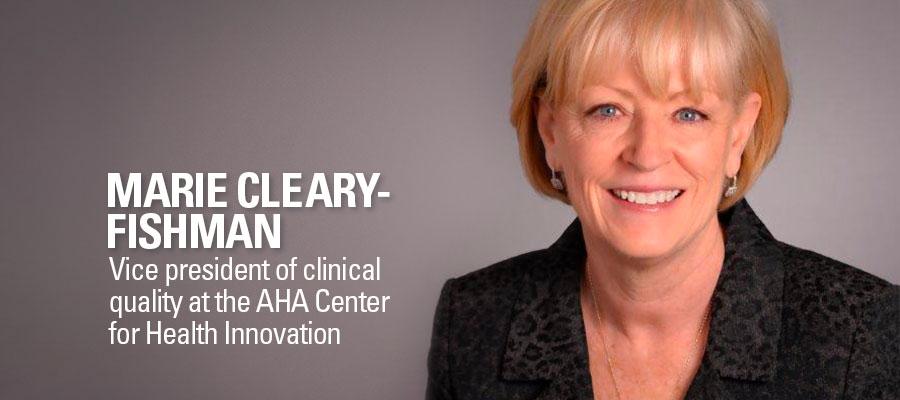
Marie Cleary-Fishman is vice president of clinical quality at the AHA Center for Health Innovation.