

Letters/Comments
Comparison of Recent 340B Bills
September, 2026
Overview
Three recent congressional proposals — the 340B for Patients Act, the SECURE 340B Act, and the SUSTAIN 340B Act — seek to make comprehensive changes to the current structure of the 340B Drug Pricing Program. Each proposal takes a unique approach to addressing critical components of the program including patient definition, use of contract pharmacies and child sites, transparency and program integrity. All three proposals also give the Health Resources and Services Administration (HRSA) more authority to oversee these components of the program. Below, is a side-by-side comparison of each proposal and how each bill would address key program components.
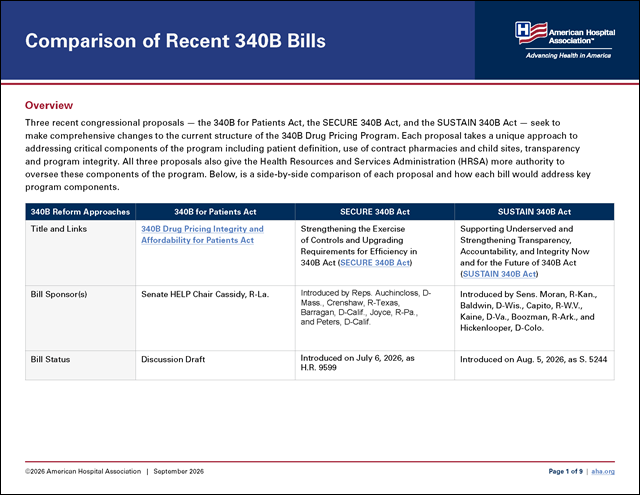
| 340B Reform Approaches | 340B for Patients Act | SECURE 340B Act | SUSTAIN 340B Act |
| Title and Links | 340B Drug Pricing Integrity and Affordability for Patients Act | Strengthening the Exercise of Controls and Upgrading Requirements for Efficiency in 340B Act (SECURE 340B Act) | Supporting Underserved and Strengthening Transparency, Accountability, and Integrity Now and for the Future of 340B Act (SUSTAIN 340B Act) |
| Bill Sponsor(s) | Senate HELP Chair Cassidy, R-La. | Introduced by Reps. Auchincloss, D-Mass., Crenshaw, R-Texas, Barragan, D-Calif., Joyce, R-Pa., and Peters, D-Calif. | Introduced by Sens. Moran, R-Kan., Baldwin, D-Wis., Capito, R-W.V., Kaine, D-Va., Boozman, R-Ark., and Hickenlooper, D-Colo. |
| Bill Status | Discussion Draft | Introduced on July 6, 2026, as H.R. 9599 | Introduced on Aug. 5, 2026, as S. 5244 |
| Concise Summary | 12-section, 88-page discussion draft amending statute to add discount-and-rebate conditions that let manufacturers satisfy 340B obligations through one of three election options, including a new retrospective rebate; also includes patient affordability requirements, contract pharmacy caps and conditions, and other integrity reforms. | 14-section, 142-page bipartisan bill which mostly maintains current program mechanisms while implementing integrity measures, including a data clearinghouse, transparency, contract pharmacy registration, patient definition and unlimited contract pharmacy usage. | 16-section, 97-page bipartisan bill that codifies contract pharmacy protections and oversight, defines patient, sunsets the 340B Rebate Model Pilot Program, adds child-site standards, transparency reporting, program integrity audits, duplicate discount clearinghouse, patient financial assistance requirements, payer/pharmacy benefit manager (PBM) nondiscrimination, a user-fee program, studies, resources, definitions and an effective date. |
| Discount vs. Rebate Effectuation | Allows a manufacturer to choose whether it wants to offer access to 340B pricing through: 1) an upfront discount, 2) a retrospective rebate, or 3) a Secretary-operated claims repository. Establishes standardized claims-data fields for a rebate or claims repository approach. | Requires manufacturers to make drugs available as an upfront discount, not through retrospective rebates, for a four-year period tied to clearinghouse performance benchmarks. | Codifies the program purpose to include requiring manufacturers to provide discounts at the point of purchase. Also directs HHS to conclude the 340B Rebate Model Pilot Program within one year, bars expansion, and transitions to the 340B Drug Discount Program Data Clearinghouse. |
| Data Clearinghouse / Repository | Establishes a data repository option for manufacturers to use with required submission of contract pharmacy and in-house claims data within 30 days of the date of the drug’s dispense for covered entities. Manufacturers can choose their own vendor for the repository. Use of the repository would require physically segregated 340B and non-340B inventories and annual attestation duties. | Establishes an independent 340B data clearinghouse, requiring an upfront ceiling-price model for four years tied to clearinghouse performance benchmarks, specifies claims data elements, and restricts manufacturer/ PBM use of clearinghouse data. | Establishes a 340B Drug Discount Program data clearinghouse through an independent third-party contractor. Covered entities would be required to provide a limited set of claims data elements and the clearinghouse would be used to facilitate exchange of data between covered entities and manufacturers. Since manufacturers would be required to make the 340B price available as an upfront price, the clearinghouse would be primarily to prevent duplicate discounts and diversion. |
| Defining a 340B Patient | Patient must have received an outpatient service at the covered entity within the preceding two years; have an auditable medical record maintained for at least three years; and have received the prescription or order from a practitioner as a result of that service or referral. | Patient must have received an outpatient service from a prescribing provider at the covered entity within two years and have received the prescription or order from a prescribing provider because of that service. | Patient must have received an outpatient service from the covered entity within the preceding two years; have an auditable medical record demonstrating the relationship for each prescription/order and retained at least three years; and have received the prescription/order from a practitioner as a result of the service or a referral. |
| Referral Prescriptions | Patient definition expressly includes prescriptions received as a result of a referral, with no entity-type limits, drug exclusions or referral-specific audit triggers. | Creates a separate referral pathway limited to certain clinics, critical access hospitals and sole community hospitals. Referrals are not eligible for other types of 340B hospitals. | Referrals would be allowed with some restrictions. The prescription must be within 12 months of the referral, be documented and filled at the covered entity’s wholly owned or contract pharmacy, and have records retained for at least three years. Infused, clinician-administered or clinician-required drugs are generally excluded, subject to limited Federally Qualified Health Center infusion exceptions. High-referral volume triggers audits at the lesser of 20% of total 340B drugs or the entity’s recent three-year average, with hardship exceptions available. |
| Contract Pharmacy /Manufacturer Obligations | Would allow use of contract pharmacies, but with a five-year contract pharmacy cap for disproportionate share hospitals, freestanding cancer hospitals and rural referral centers (mail-order pharmacies do not count toward the cap), plus a service area requirement for eligible contract pharmacies. Requires manufacturers to ship or facilitate shipment to registered contract pharmacies on covered entity request, subject to conditions; no obligation to discount/ rebate drugs delivered outside registered addresses. | Would allow use of multiple contract pharmacies with no geographic limitations. Mandates manufacturers offer covered outpatient drugs at or below the ceiling price and ship to coveredentity-directed pharmacies; may not impose distribution restrictions or data-submission conditions. | Manufacturers must offer covered outpatient drugs at or below the ceiling price regardless of whether dispensed directly or through a contract pharmacy; must deliver or allow delivery to covered-entityrequested locations; and may not restrict distribution options, require claims data except to the clearinghouse, or impose other prohibited conditions. Would allow use of multiple contract pharmacies with no geographic limitations. A covered entity must cancel any contracts with no volume of drugs in the most recent 12-month period. |
| Data Submission Requirements | In the event of a rebate or data repository mechanism for accessing 340B pricing, covered entities would be required to submit data for contract pharmacy claims. | Manufacturers could NOT impose any data requirements to access 340B pricing through contract pharmacies. | Manufacturers could NOT impose any data requirements to access 340B pricing through contract pharmacies. |
| Child Site Eligibility Standards | Hospital child sites are eligible for 340B if they are wholly owned and meet all Medicare provider-based requirements. They also must provide services that are not just limited to drug dispensing or infusion and extend the same patient financial assistance policies as the parent entity. A child site is only eligible if its charity care as a share of total revenues is greater than or equal to that of the hospital’s on-campus outpatient clinics OR the average across all inpatient prospective payment system hospitals in the state. | Hospital child sites are eligible for 340B if they meet Medicare provider-based requirements. Child sites must be clinically and financially integrated with the parent 340B entity and extend the same patient financial assistance policies as the parent entity. | Hospital child sites are eligible for 340B if they meet Medicare provider-based requirements. Child sites must be clinically and financially integrated with the parent 340B entity and extend the same patient financial assistance policies as the parent entity. |
| Child Site Community Need / Location Restrictions | Eligible child sites must be located in a HRSA shortage-area designation. | Child sites must meet community need standards as defined by CDC’s Social Vulnerability Index. | No Social Vulnerability List, shortage area, or revenue share location requirements. |
| Moratoriums on New Child Sites | None. | None. | Would impose a three-year moratorium on newly acquired child sites that were not already eligible, subject to a case-by-case hardship exception. This would not apply to any newly constructed child sites. |
| Financial Assistance Requirements | Requires hospitals to establish a sliding fee scale capping out-of-pocket costs by income tier and extends requirements to contract pharmacies and child sites. | Requires hospitals to maintain and extend their financial assistance policy to child sites and contract pharmacies, with a sliding fee scale and nominal copays. | Requires each hospital to extend their financial assistance policy to patients at or below 200% of the federal poverty level. Financial assistance policies extend to patients at contract pharmacies and child sites, but only apply after three years. |
| Medical Debt Protections | None. | Prohibits certain hospital debt-collection practices, including selling patient debt, adverse credit reporting, and denial/deferral of care for nonpayment; limits collection to patients with ability to pay and caps interest. | None. However, there is a requirement for the GAO to study 340B hospital debt collection practices. |
| Reporting Requirements | None. | Requires annual reporting as a Medicare cost-report addendum, including patient counts, prescriptions by coverage type, charity care levels, use of savings, financial demographics, third-party administrators (TPAs) and contract pharmacy locations; HHS publishes aggregate and entity-identified data within 30 days. | Requires annual reporting to HHS within one year after enactment and annually thereafter on patients dispensed/administered 340B drugs, prescriptions by insurance type, charity care, optional under-reimbursed care, a standardized description and officer attestation on the use of savings, financial demographics, medication access/adherence policies, nongovernmental hospital state/local contracts, third-party administrators, Medicare/Medicaid funding shortfall, outpatient service patients and 340B operating costs. HHS must publish information within 90 days in a searchable electronic format, both in aggregate and by covered entity type, and submit annual reports to Congress. |
| Audits | Establishes broad authority to conduct routine and for-cause audits by the Secretary and manufacturers, with the option to use manufacturer internal audit staff. Audits apply to all aspects of the 340B program including the discount/rebate systems. | Authorizes the Secretary to conduct audits of covered entities, contract pharmacies, child sites and manufacturers, and requires biennial independent third-party audits of each covered entity with corporate-officer certification and manufacturer repayment above a de minimis threshold. | Authorizes contract pharmacy audits by the Secretary and manufacturers following credible allegations and good-faith outreach; patient-status audits by the Secretary no less frequently than every three years, with more frequent audits for high-risk/high-volume entities; audits of program-savings records; and additional audits of covered entities, child sites, contract pharmacies and manufacturers. |
| Corrective Action / Disenrollment | Applies a “three strikes and you’re out” rule for contract pharmacy violations. Also includes strict standards for patient definition and other statutory violations including disenrollment. | Creates broad requirements for corrective action plans, temporary suspension, and after repeated violations or failure to correct violations, disenrollment may occur. | If a covered entity fails patient-status or referral requirements, the bill requires a corrective action plan, possible ineligibility for up to three years, and potential civil monetary penalties. A covered entity may be disenrolled if it fails to implement a corrective action plan within 180 days for violations involving eligibility, diversion, duplicate discounts, contract pharmacy requirements, improper drug claims, or failure to comply with program-savings reporting/use requirements. |
| Entity Registration / Recertification Process | Includes added strict requirements for entity registration and annual recertification process. | Requires the Secretary to verify private nonprofit hospitals’ state/local contracts and nonprofit status via IRS/CMS data before registration or annual recertification. | Requires the Secretary to obtain, review, verify and document private nonprofit hospitals’ contracts with state/local governments before registration and recertification. |
| Payer / PBM Anti-Discrimination Policies | None. | Would prohibit plans, issuers and PBMs from discriminatory reimbursement practices, fees or network exclusion based on 340B status. Violations could result in civil monetary penalties up to $5,000/violation/day. | Prohibits plans, issuers and PBMs from discriminating against covered entities, 340B pharmacies, or patients based on 340B status. Prohibited conduct includes lower reimbursement, discriminatory fees/ chargebacks/clawbacks, network restrictions, expanded audit burdens, interference with patient choice or delivery, requiring identification of 340B drugs, refusal to contract based on 340B status, denial of drug coverage because a drug is a 340B drug, forcing pharmacy choices inconsistent with 340B requirements or patient need/access, and failure to enable point-of-sale differentiation between private and Medicaid plans. Violations could result in civil monetary penalties up to $5,000/ violation/day. |
| TPA & Contract Pharmacy Fees | Would cap TPA and contract pharmacy remuneration at flat, fair-market-value fees not tied to drug prices; contract-pharmacy fees may not exceed 125% of average third-party dispensing fee. | Would limit TPA compensation to bona fide service fees not tied to drug revenue or dispensing volume. | Does not impose any cap on TPA or contract pharmacy compensation. 340B hospitals must report all contracted TPAs and vendors to HRSA. |
| Changes to the 340B Prime Vendor Program | Requires at least two prime vendors free of any conflicts of interest. Prime vendor cannot be affiliated with covered entities or group purchasing organizations. Prime vendor cannot charge any enrollment or participation fees and must ensure all educational services are free of charge. Any data maintained by the prime vendor must be made available to the Secretary with full rights. | None. | None. |
| User-fee Program | None. | Establishes a 0.1% user-fee on covered-entity drug purchases starting in 2027. | Establishes a covered-entity user-fee program beginning in FY 2031, with $50 million in total fees for FY 2031 and inflation adjustments thereafter. Fees are allocated by each covered entity’s share of covered outpatient drug prescriptions and collected quarterly. |
| Studies / Reports | Authorizes OIG to conduct annual studies of patient assistance and out-of-pocket obligations under the 340B program. | Authorizes multiple GAO/Secretary studies on cost of dispensing, 340B discount retention across the supply chain, hospital debt collection practices and state/local contract analysis. | Authorizes multiple reports on referral prescriptions, child site program integrity measures and best practices, hospital debt-collection practices, dispensing fees, interactions of the claims data clearinghouse and other federal drug programs, and the sustainability of the user-fee program. |
Key Resources
Related Resources
Letters/Comments