

How Reid Health uses AI to save time, improve retention and elevate patient experience
Reid Health
Richmond, Ind.
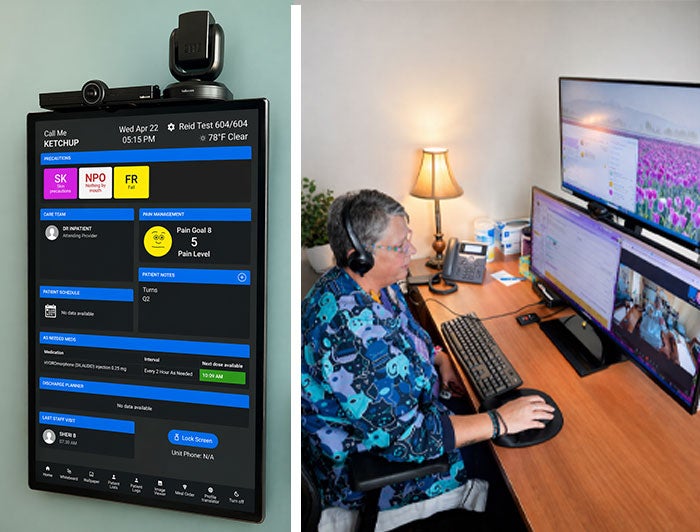
Photos of smart display and virtual nursing station courtesy of Reid Health.
“This was never about technology,” said Muhammad Siddiqui.
That sounds like a strange way to describe the project that made Reid Health one of the finalists for the 2026 AHA Rural Hospital Excellence in Innovation Award. Through a partnership with HelloCare.ai, the Richmond, Ind., hospital system began using Abridge, a generative AI system, to document clinician-patient conversations. Since 2024, every inpatient room has also been equipped with Epic-synced digital whiteboards, virtual nursing capabilities and virtual sitting technology. But how is this innovation not about technology?
“What I was hearing from our teams was that they were losing the joy and purpose in their work,” said Misti Foust-Cofield, vice president and chief nursing officer at Reid Health. Clinicians were spending time documenting patient interactions not only during visits, but also long after their workday was supposed to end. AI technology was the solution — if it was implemented correctly. “AI only matters if it gives time back to people,” said Siddiqui, vice president and chief information officer. “If it doesn’t do that, it’s just noise.”
On average, the real-time documentation available through Abridge saved 10-12 minutes per clinical note, leading to an 86% same-day note completion rate and a significant drop in after-hours documentation. Suddenly, providers were no longer going home, having dinner and then cracking open their laptops to complete their cases.
Patient satisfaction increased, too. “Patients would leave a Google review and say ‘this doctor is using this tool ... What an amazing technology, and I love to see that a small hospital has this for their patients,” Siddiqui said. Adopting the technology has also had implications for the workforce. Retention has improved, said Foust-Cofield, and “we have some of the highest capstone numbers that we have seen, with having new or soon-to-graduate nursing students want to come and shadow here” because the technology allows nurses and other providers to spend more time with a patient and less time with a keyboard.
“It’s a statement to our community that we want to be innovative,” Foust-Cofield said. “We want to push the limits to provide this community with absolutely excellent care.”
The recognition from the AHA had both internal and external benefits. “We are a very driven organization and oftentimes we’re going from one project to the next because we love to push things forward," said Foust-Cofield. “But this really gave us time to sit back and celebrate the great work that’s happening here day to day.”
“And we really want other rural health systems to look at Reid Health and say ‘hey, if they can do it, why can’t we?’” added Siddiqui. “We want to develop the playbook — and then we want to share it. That’s what the goal is.”
The AHA Rural Hospital Excellence in Innovation Award is sponsored by Microsoft. Microsoft is committed to supporting all rural hospitals in the U.S. with affordable access to cybersecurity, cybersecurity risk assessments and innovation to address root challenges.