

Letters/Comments
August 2026
The 340B Drug Pricing Program was established by Congress to ensure that hospitals serving low-income, rural and medically underserved communities are able to stretch limited federal resources and use their savings to maintain, improve and expand access to care. Since the program’s inception in 1992, the Health Resources and Services Administration (HRSA) has implemented the program as an upfront discounted price available to covered entities at the point-of-sale. In August 2025, HRSA first announced its intent to test a rebate model in place of upfront discounts under a pilot program. In December 2025, a federal court enjoined the agency from moving forward with this rebate program. Subsequently, the agency issued a request for information that the agency then used to introduce a revised version of its rebate program in August 2026 with a start date of January 1, 2027. The agency’s new rebate program would apply to all 2026 and 2027 initial price applicability year drugs negotiated by Medicare under the Inflation Reduction Reduction. As explained below, this fundamental change upsetting three decades of agency precedent shifts the financial risk to 340B covered entities, introduces significant and unnecessary administrative burden, and undermines the statutory purpose of the 340B program: to expand access to care for patients and communities across the country.
Under the current 340B framework, eligible hospitals and clinics purchase outpatient drugs at discounted 340B prices at the point of sale. Access to an upfront discount provides predictable, enforceable pricing that allows hospitals to:
In contrast, under a rebate model, hospitals and clinics would no longer receive the 340B discount at the time of purchase. Instead, hospitals would be required to:
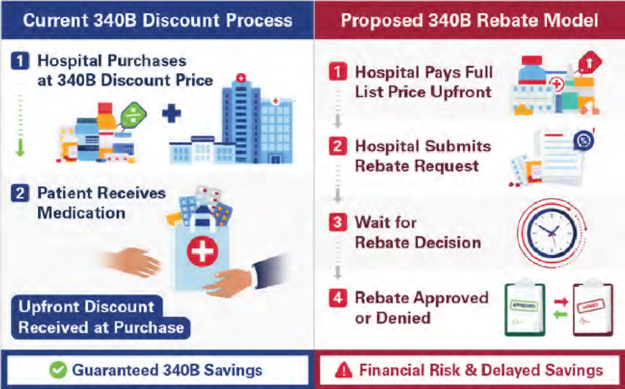 Pay the full list price for outpatient drugs.
 In effect, hospitals would be asked to finance drug purchases upfront while relying on manufacturers to voluntarily return the statutorily-owed discount after the fact.
The AHA strongly opposes replacing upfront 340B discounts with any rebate model. Any changes to the 340B program must preserve point-of-sale pricing, ensure predictable access to savings, maintain independent federal oversight, and protect patients and 340B providers. In addition, the AHA opposes any efforts to carve out individual types of 340B covered entities from a rebate model, as this would undermine the partnerships among providers that coordinate delivery of patient care.
The AHA also is committed to ensuring 340B program integrity and transparency. We support the creation of a neutral, third-party clearinghouse model that would strengthen the government’s oversight of the 340B program, minimize administrative burdens for all stakeholders, and ensure continued access to upfront 340B discounted pricing while mitigating any unintended consequences for access to care.
Congress structured the 340B program to provide upfront pricing certainty — not a back-end rebate. We believe that the costs to patients and 340B providers are too high to justify any rebate model and urge Congress to ensure that upfront 340B pricing is maintained