

Chair File: Leadership Dialogue — Creating a Culture of Innovation with James Merlino of Joint Commission
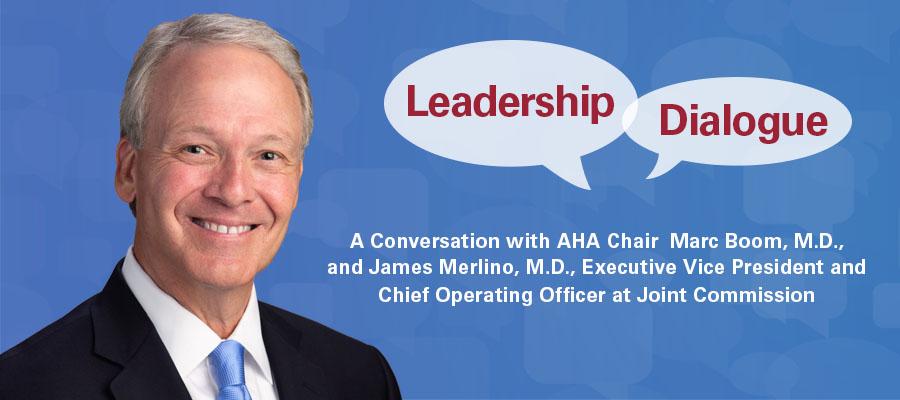
This year I’ll be continuing the AHA Leadership Dialogue series and talking with health care, business and community leaders on trending topics in the field.
Joining me for the first dialogue in 2026 is James Merlino, M.D., executive vice president and chief operating officer at Joint Commission. Jim focuses on the transformation of Joint Commission’s services utilizing data and innovation to advance health care safety and quality. Previously, he served as the chief clinical transformation officer at Cleveland Clinic.
Jim and I discuss building a culture of innovation, unleashing the power of new technologies to advance health care, and developing partnerships to access and share expertise, information and best practices.
I hope you find these conversations interesting and insightful. Look for them once a month as part of the Chair File in 2026.
View Transcript
00:00:00:03 - 00:00:23:09
Tom Haederle
Welcome to Advancing Health. In this first leadership dialogue podcast of the year, Dr. Marc Boom, president and CEO of Houston Methodist and the 2026 Board Chair of the American Hospital Association, speaks with a top leader at the Joint Commission about the factors that drive organizational innovation.
00:00:23:12 - 00:00:51:28
Marc Boom, M.D.
Well, greetings, everybody, and thank you so much for joining me today. I'm Dr. Marc Boom. I'm here with you today as I am privileged to start serving my term as the board chair of the American Hospital Association for 2026. This is a great honor, great privilege, and it's something I take very seriously. And I can't think of a more interesting time and an opportunity with more promise than leading the American Hospital Association's members, who work every single day to make health care better for all Americans.
00:00:52:00 - 00:01:12:03
Marc Boom, M.D.
Part of this new role is making sure we are continuously learning, and I believe these leadership dialog series are a great way to listen to and learn from others as a strategy to always seek to be better and better informed. To give a little background on me and my experience leading a hospital system since this is our first podcast.
00:01:12:06 - 00:01:36:27
Marc Boom, M.D.
I've been very fortunate to be at Houston Methodist now for 28 years, almost 29 years. I've been privileged to be CEO for the last 14 years or so. We're a very large organization, 35,000 employees, flagship Academic Medical center, the Texas Medical Center, and seven network hospitals that span throughout the greater Houston area. We have an active research institute, GME programs, etc..
00:01:36:29 - 00:01:57:27
Marc Boom, M.D.
And today, as we start this series and really wanted to focus on a foundational element, which is innovation. Because I believe this is a critical skill set for hospital leaders today. And so we're going to weave that theme throughout the year, along with a lot of other things. At Houston Methodist, innovation has been part of our DNA for a long time.
00:01:57:27 - 00:02:19:03
Marc Boom, M.D.
And we've really pushed it very hard, rethinking how we do things, being more agile in what we do, and trying technologies like virtual nursing, ambient listening in the operating rooms, wearable technologies. We have a saying at Houston Methodist when we try new technologies: we will succeed fast or we will fail fast. We also have two guiding principles for innovation.
00:02:19:06 - 00:02:41:23
Marc Boom, M.D.
The first is to obsessively focus on the needs of our patients, families and communities. That's why we are innovating. But a very close second is to make the lives of our clinicians and employees easier, so we can free them up to do what humans do best, which is actually the personal interaction in health care and what really connects them to the people we serve.
00:02:41:25 - 00:03:11:12
Marc Boom, M.D.
And I know that trying new and innovative solutions is nothing new for my guest today. I'm very pleased today to be joined by Dr. Jim Merlino, who was recently appointed a couple of months ago to serve as the chief operating officer of the Joint Commission. Prior to stepping into that new role, he served as the organization's chief innovation officer. And before that, he was the chief clinical transformation officer at the Cleveland Clinic, where he oversaw strategy, business development, safety, quality, patient experience, and continuous improvement.
00:03:11:14 - 00:03:21:04
Marc Boom, M.D.
So his experience and expertise make him a perfect guest for today's discussion. So let's welcome Dr. Jim Merlino, and let's jump on into our discussion. Jim, welcome.
00:03:21:07 - 00:03:31:25
James Merlino, M.D.
Thank you. Marc. Honored to be here. And congratulations becoming the chair of the American Hospital Association. Can't think of a better person. To be leading that organization in times like this.
00:03:31:27 - 00:03:51:16
Marc Boom, M.D.
Well, thank you very much. It's great to see here. Now, if my memory serves correctly, it's been a while, but the very first time we actually met was regarding institutional culture. So I know you think a lot about culture and you know the importance of culture, so I'd love to get your thoughts around that. How important is it when you're tackling innovation?
00:03:51:16 - 00:03:58:04
Marc Boom, M.D.
How do you use culture to drive quality safety, service, innovation. How do you do that?
00:03:58:06 - 00:04:23:00
James Merlino, M.D.
Yeah, well it is absolutely essential. And you know, when you first asked me to participate in this conversation, my initial thought was you know, I'm being questioned by a person that understands this better than I do because, you know, we first met when I was the chief experience officer for Cleveland Clinic under Toby Cosgrove, and we came to Houston Methodist to talk to you and talk to the team to learn about how you leverage culture to really build an incredible organization.
00:04:23:00 - 00:04:45:27
James Merlino, M.D.
And I remember we were touring the basement, and you showed me the floodgates and told me a story about how the hospital flooded after the hurricane and how you use that as a as a rallying point to really start to rebuild the organization. You know, I think in my career and I think you see it across the country, certainly within your organization, if you don't tackle the culture of an organization, particularly in health care, you're never going to achieve any of your goals.
00:04:46:05 - 00:05:01:29
James Merlino, M.D.
It is really foundational. You still have a saying, the clinic has a saying that, you know, if you don't, it's kind of like, how do you drive safe, high quality, patient centered care? You tackle your people and you make sure that they have the tools they need, that they are coming to work engaged, they love their job,
00:05:01:29 - 00:05:22:06
James Merlino, M.D.
they're feeling satisfied. You're meeting their needs. If you don't focus on that - organizations don't focus on that - you're never going to achieve your goals. That's essential for not only the basic elements, the table stakes and health care, but if you want to create an organization, particularly in health care, that's focused on trying to do new things and innovate, you need to harvest those ideas from your people, right?
00:05:22:06 - 00:05:29:15
James Merlino, M.D.
That's where the best ideas come from. The people that work in your organization, working closely with the people you serve, your patients and families.
00:05:29:18 - 00:05:33:27
Marc Boom, M.D.
That's great. So what do you do specifically to build that culture of innovation?
00:05:33:29 - 00:05:55:26
James Merlino, M.D.
Number one, I think we have to get leaders to recognize that culture is actually something you can develop. It's not something that just exists. You can invest in your culture. You can shape your culture. You can have your leaders help to define it and to grow it and to transform it. So investing in your people and your people development is a really critical component of it. Including measuring engagement, right?
00:05:55:26 - 00:06:19:25
James Merlino, M.D.
Are you ensuring that you're understanding what's important your people's minds? The second thing is giving them opportunities. And you talked about this at Houston Methodist, right? It's not the or, it's the and. It's like we need you to deliver great care, and we want to make sure that we're listening to you to harvest the information that we need to be able to build the organization that we want to deliver that great care.
00:06:19:28 - 00:06:39:23
James Merlino, M.D.
So I think it's a component of investing in your people, recognizing that culture is something that can be shaped, it can be molded, it can be developed, it can be improved. And giving your people the tools and the opportunities to speak up, to engage in that innovative culture, to share their ideas, to share their thoughts, to provide feedback.
00:06:39:23 - 00:06:46:03
James Merlino, M.D.
Those are two essential elements that I think health care leaders across the industry need to recognize.
00:06:46:06 - 00:07:03:29
James Merlino, M.D.
I think that's spot on. I always talk about intentionality. It is intentional. Culture is something, whether you're talking about any aspect of a culture, when you are intentional about what you do, you get the culture you want. When you don't have that intentionality, you don't get the culture you want. Unless you're lucky. And so that's critically important.
00:07:03:29 - 00:07:22:02
James Merlino, M.D.
So, okay, you've got the culture and you work on the culture, you build that, you work with your people. Now, you really talking about some of the technologies and how those intersect. And some of those technologies are so exciting. Some of these are kind of scary at the same time, right? What do you see as the opportunities at the intersection between technology and health care for our future?
00:07:22:08 - 00:07:27:15
Marc Boom, M.D.
I'd love to hear the thoughts about, you know, how that interplays with the Joint Commission as well.
00:07:27:18 - 00:07:57:23
James Merlino, M.D.
Well, you know, it's interesting because I think technology has always been with us in health care in some form. If you look at the innovations of the last 100 years in medicine alone, right? There's been tremendous advances. And now in the last few decades, those advances have just been accelerating where the curve is nearly straight up. But when you think about what we have with us today in terms of artificial intelligence, machine learning, etc., the opportunity to take new technology, new ideas and apply that to what we do is really unlimited.
00:07:57:23 - 00:08:16:04
James Merlino, M.D.
I mean, you are doing it now at Houston Methodist as well as others. I recently had the opportunity to visit your flagship and look at some of the things you're doing. And I think the exciting thing about technology today is that we really have an opportunity to use those new technologies to help liberate our people. Exactly what you said, right?
00:08:16:04 - 00:08:42:28
James Merlino, M.D.
We want to get people back to the personal touch of caregiving, AI. Machine learning, I don't think I hope will never replace the human touch, the human component, but it should be able to help the human component to be able to deliver that personalized care that people need in their healing process. I think from a Joint Commission standpoint, from the perspective of AI, you and I cannot imagine what AI is going to do for health care in ten years.
00:08:42:28 - 00:09:01:00
James Merlino, M.D.
I mean, when I was in college, right, my cell phone was, you know, it's five times the size of my current computer that I'm on, right? And now think about it, right. We are walking around with very sophisticated, very powerful computers in our palms. We could have never imagined that back when we were in college or high school.
00:09:01:02 - 00:09:30:21
James Merlino, M.D.
So I don't think we can really imagine how AI is going to transform, how technology is going to transform what we have in front of us for an opportunity. Our perspective is we can't regulate AI, right? We want to unleash the power that AI and technology can bring to benefit patients, and also to benefit caregivers. Our perspective is, you know, let's provide guidance on what you should be thinking about, because, as you know, in health care, particularly in your role at the AHA, is there's the haves and the have nots.
00:09:30:21 - 00:09:49:17
James Merlino, M.D.
There are big organizations that can invest in technology and resources, like yours. And then there's small organizations. We want to make sure that we're providing guidance on what people should be thinking about. We don't want to be saying, here's what you need to do, because the last thing we want to do is stifle the innovation that people can have with this technology.
00:09:49:23 - 00:09:57:03
James Merlino, M.D.
We just want to make sure that people are thinking about what's important for their organization and to protect patients. That's kind of our thinking about this.
00:09:57:05 - 00:10:14:09
Marc Boom, M.D.
So we talked about that foundation of culture and innovation within, but some innovation comes from outside, and is how we implement and how we move quickly with it. Talk about the partnerships that need to be part of the equation when we're thinking about innovation in health care.
00:10:14:12 - 00:10:34:08
James Merlino, M.D.
I think that sometimes organizations look at what they're doing and think that the best things happen here, right? And one of the things that I learned in the various roles that I've been fortunate to have in my career is that there's a lot of great things happening out in the market, and we should take advantage of learning from others and seeing what others are doing.
00:10:34:15 - 00:11:08:27
James Merlino, M.D.
To understand whether I could apply for what we're doing, apply to what we're doing or not, right? Learn from each other, share information. That's what our opportunity is. I think that if we look too much internally only and that look to partners, then we're going to be blinded by what the potential is. And I think about organizations like ours, like the American Hospital Association, the ability for us to lever these platforms to ensure that organizations have access to information, to have access to best practices, to be able to see what others are doing is really unlimited.
00:11:08:27 - 00:11:18:12
James Merlino, M.D.
And that's our opportunity is to help those organizations get exposure to that and get access to that so that they can judge for themselves whether the think is something they can use.
00:11:18:14 - 00:11:37:03
Marc Boom, M.D.
When you're judging those, what are you really jazzed up about? What makes you excited about the future of technology and what how big do you think this impact is? Put that in, I guess in in the scope of other big innovations within health care, how what's the potential opportunity here? What are the big exciting things coming down the pike?
00:11:37:06 - 00:12:06:10
James Merlino, M.D.
I think it's unlimited. I mean, again, going back to my comment earlier about what's our imagination to be able to say what it looks like in ten years, I don't think we can imagine that. Right? I think that it is limited by only our imagination, what we think we can bring to it. When you consider the advances in technology and the advances in disease treatment, just in my medical career alone. When I was a medical student, right, think about it - half the medicine wards were filled with people dying of AIDS.
00:12:06:12 - 00:12:29:16
James Merlino, M.D.
Today, HIV is a chronic medical condition and people are treating it with basically no detectable virus in their blood. And AIDS is nearly nonexistent in the United States. I mean, that's an amazing technological leap in terms of treatment in medicine. And I think the limit for what technology, whether it's science or AI or other things, can bring to medicine?
00:12:29:19 - 00:12:35:19
James Merlino, M.D.
There's no limit, right? I can't imagine the ability of what it's going to bring to the field.
00:12:35:21 - 00:12:52:02
Marc Boom, M.D.
Is there any particular challenge problem that you come across with the Joint Commission? You look into so many hospitals, as you mentioned, from really the entire spectrum of size that you wish technology could be brought to bear to fix first?
00:12:52:05 - 00:13:21:08
James Merlino, M.D.
For me, and this is a personal perspective, it's a little bit about what you touched on earlier, right? It's how you lift the burden from caregivers? You know, in some ways, technology has created a burden. I think about the electronic medical record. My wife is the chief medical informatics officer for the Cleveland Clinic. And her and the team spent a lot of effort helping physicians understand how to use the EMR as a tool in their workflow to deliver better care and reduce burden.
00:13:21:15 - 00:13:47:11
James Merlino, M.D.
Right. But if you look at the rollout of the electronic health record across the United States, across the world, when it started, what we did was we took the technology and we put it on top of bad processes. And now you had two things that weren't working well together. It was only after you think about how you get it to work more closely, how you evolve your workflows to get it to work more efficiently, to get it to work in a way that benefits caregivers and patients.
00:13:47:13 - 00:14:15:25
James Merlino, M.D.
I think that as we roll out new technologies, we look at new opportunities, we have to be mindful of how is it going to impact the caregivers, right? Ensuring that the promise of reduction of burden is reality and is going to impact them in a way that benefits their delivery of care and ultimately benefits patients. But I think that is what's really most important for me is how do you get to lift the burden for caregivers and ultimately improve the delivery of the care that they're doing.
00:14:15:27 - 00:14:39:14
Marc Boom, M.D.
I think that's spot on. That's why that was the second of our sort of philosophical aims with technology, because we all know burnout is a very real thing. We all know many of the things that cause burnout are - as our chief physician executive calls it - the pebbles in the shoe, they're the irritating things that just kind of get at you and over time just even get worse and worse, as if it was a pebble in a shoe.
00:14:39:15 - 00:15:01:00
Marc Boom, M.D.
Yet technology can take so much of that away. And when you put the patient at the center and you think about that one on one relationship or those close personal relationships, I'm a primary care physician, so that's important to me as well. I think technology has the dramatic potential that enable it. The other thing I'd probably throw in there, and I'd love to hear your thoughts about that.
00:15:01:03 - 00:15:19:08
Marc Boom, M.D.
I think one of the big challenges we face in health care, if not maybe the biggest existential question is affordability. For me, it's the big A right now. To be honest, I'm not sure much of technology has ever really improved affordability and health care, but I think we're on the cusp where that could happen. Do you agree with that?
00:15:19:09 - 00:15:27:28
Marc Boom, M.D.
Is that something plausible that we could actually help end some of the cost curve, make health care more affordable by implementing technology appropriately?
00:15:28:00 - 00:15:50:00
James Merlino, M.D.
I agree, and I think it's true. And particularly if you consider access issues. When you look across the country, you know, you have tremendous opportunities to improve access in rural health, for instance. And I think technology is a way to extend that delivery of care into communities, into areas that don't have the resources that you see in the big cities and urban areas with big systems.
00:15:50:03 - 00:16:03:27
James Merlino, M.D.
And, you know, we should be thinking about how we use technology to extend in those areas. Coming back to the issue of adoption, you know, I think that the pebble in the shoe analogy is a great line. I'm going to steal that.
00:16:03:27 - 00:16:07:15
Marc Boom, M.D.
Steal away. I stole it from our chief physician executive. So it's just breaking down the chain here.
00:16:07:17 - 00:16:28:26
James Merlino, M.D.
But think about it. If we're going to be successful at implementing technology, we should look to the challenges we've had in the past with technology implementation, right? and ensure that as we're leveraging new technologies, particularly AI, we're using our people, our physicians, our nurses, other professionals and health care to really help us understand how to apply it appropriately.
00:16:29:02 - 00:16:49:06
James Merlino, M.D.
Right? Because I think sometimes we lose track of that. Right? People are sitting in the ivory tower. They want to implement something that seems really exciting and really new, but we have to remember that we're giving this to the people that are delivering the care. We want to make sure that we're levering them to help us understand not only the best uses for it, but actually how to implement it.
00:16:49:08 - 00:17:08:04
Marc Boom, M.D.
Well, that's great. Thank you, Joe. I mean, this is exactly why I asked you and I'm so thankful that you agreed to be the first guest this year on this series is because I know you understand the inner workings of this and obviously have had a huge impact in your career at the Cleveland Clinic and now a huge impact across so many hospitals with the Joint Commission.
00:17:08:04 - 00:17:17:22
Marc Boom, M.D.
So thank you very much. Very insightful conversation. I enjoyed it a great deal, and thank you for everything you do in service of humanity through your through your roles.
00:17:17:24 - 00:17:25:18
James Merlino, M.D.
Well, thank you very much for having me. And I appreciate the conversation and look forward to the great things you're going to do at the American Hospital Association.
00:17:25:20 - 00:17:36:05
Marc Boom, M.D.
Thanks so much. Well, everybody, thank you so much. I hope you enjoyed this as much as I did. And thanks for taking your time to listen. We'll be back next month for another Leadership Dialog conversation.
00:17:36:08 - 00:17:43:14
Tom Haederle
Thanks for listening to Advancing Health. Please subscribe and rate us five stars on Apple Podcasts, Spotify, or wherever
00:17:43:14 - 00:17:44:18
Tom Haederle
you get your podcasts.