

Chair File: Leadership Dialogue — Advancing Quality Behavioral Healthcare With John Santopietro, M.D., of Hartford HealthCare
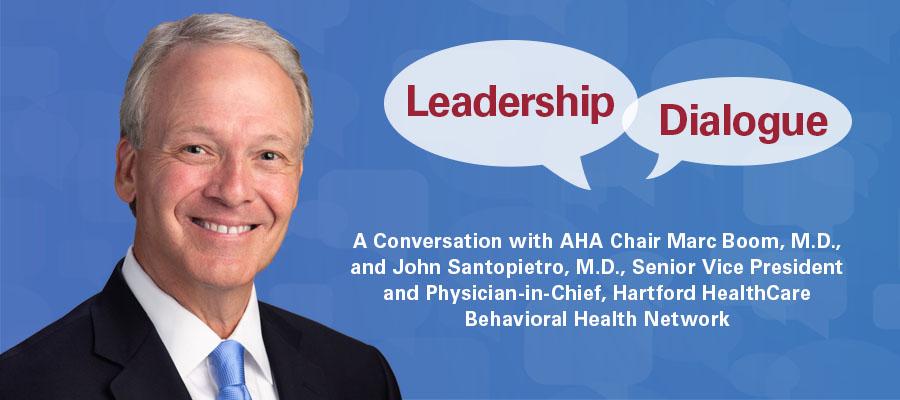
Behavioral health is healthcare, and hospitals and health systems are working to ensure we provide holistic care for our patients, their families and our team members.
In this episode, I am joined by John Santopietro, M.D., senior vice president of Hartford HealthCare and physician-in-chief of its Behavioral Health Network. John has served on the AHA’s Committee on Behavioral Health and the Regional Policy Board.
John and I discuss the network’s structure and approach; its research work, including biotyping; initiatives to recruit behavioral health professionals; and its Radical Recovery program. We also talk about using artificial intelligence in treating mental health illnesses and substance use disorders.
Hartford HealthCare was the 2025 recipient of AHA’s Quest for Quality Prize. John shares how convening clinical councils focused on early detection, early intervention, drug-dosing algorithms, wraparound services and other topics are advancing high-quality, evidence-based behavioral healthcare.
I hope you find these conversations interesting and insightful. Look for them once a month as part of the Chair File in 2026.
View Transcript
00;00;00;10 - 00;00;19;03
Tom Haederle
Welcome to Advancing Health. The demand for behavioral health services continues to grow, and providing the necessary resources can be a challenge. In this Leadership Dialogue podcast, we learn how a New England health system is navigating these issues and delivering for its patients.
00;00;19;06 - 00;00;52;06
Marc Boom, M.D.
Greetings and thank you everyone for joining me today. I'm Marc Boom, the president and CEO of Houston Methodist and the board chair of the American Hospital Association. As we continue this set of discussions, we're going to focus today's conversation on the very critical issue of behavioral health. Behavioral health has long been, unfortunately, both stigmatized and underfunded. And yet, with the mental health crisis in our country worsening, the hospital field should innovate and advocate for solutions to help both patients and families, as well as our own caregivers, who have seen increased rates of anxiety and burnout.
00;00;52;07 - 00;01;16;11
Marc Boom, M.D.
I know at Houston Methodist, as with many other organizations, we are very dedicated to caring for our patients overall health, their physical and their emotional well-being. We've embraced a holistic, collaborative approach to incorporating behavioral health services into the organization and offer both inpatient and outpatient programs and services. Our caregivers work collaboratively in a team based structure that allows them to draw on clinical expertise and medical innovation.
00;01;16;13 - 00;01;38;16
Marc Boom, M.D.
So today, I am pleased to be joined by Dr. John Santopietro, an expert in the field. Dr. Santopietro is currently the senior vice president and physician- in-chief at Hartford Healthcare's Behavioral Health Network. Before that, he was president and medical director of Silver Hill Hospital and had served on the AHA's Committee on Behavioral Health and the Regional Policy Board.
00;01;38;17 - 00;01;46;18
Marc Boom, M.D.
So let's jump into our discussion. John, I look forward to learning from your expertise and hearing about the opportunities innovations you're seeing. Thanks for joining us today.
00;01;46;20 - 00;01;56;20
John Santopietro, M.D.
Well, thank you for having me. And thank you for centering behavioral health. And it sounds like you guys are doing amazing things in your system to make sure you're giving excellent care. So I'm honored to be here.
00;01;56;23 - 00;02;06;16
Marc Boom, M.D.
Well, fantastic. Well, I'd love to hear a little bit more about the Hartford Health Care Behavioral Health Network, what it encompasses, what's led to your current structure and approach?
00;02;06;19 - 00;02;30;21
John Santopietro, M.D.
Yeah, so not unlike your system, at Hartford Healthcare, we are very focused on behavioral health. So just briefly, I'm a psychiatrist. I took a course on Freud when I was a sophomore in college, and that was it. I loved doing the clinical work, but my first job was in an inner city hospital just outside of Boston about 26 years ago, and I saw how broken the system was, and I couldn't stay out of the fight to make things better.
00;02;30;21 - 00;02;55;28
John Santopietro, M.D.
So that's sort of my leadership journey. I've been in a number of systems, always focused on bringing the best care to the most people. I've been at Hartford Healthcare for going on seven and a half years now. So Hartford Healthcare is about a $7.5 billion integrated delivery system, not for profit in Connecticut. But even for a system that size, we have a almost an outsized engine of behavioral health.
00;02;55;28 - 00;03;24;19
John Santopietro, M.D.
So we have 4,000 people working in behavioral health in our system. We do about going on 700,000 outpatient visits a year, going on almost 200,000 inpatient days a year. We have education, we have three residencies, we have fellowships. We actually have a fair amount of research for an organization like ours. So since 2007, we're upwards of $100 million worth of behavioral health research just in this system.
00;03;24;19 - 00;03;33;14
John Santopietro, M.D.
So it's an incredible chassis, so to speak, for what I'm trying to do in my leadership and behavioral health, again, which is the best care to the most people.
00;03;33;20 - 00;03;38;19
Marc Boom, M.D.
That's amazing. So $100 million in research, where is that funded from?
00;03;38;19 - 00;04;09;09
John Santopietro, M.D.
Mostly places like NIH and NIMH, but also substance use agencies and local foundations. And we do also have some industry sponsored drug research going on from time to time. But primarily it's from NIH and NIMH. We actually just got an $8 million grant from NIH to enhance our research facilities. We're working in this one laboratory on what's called bio typing.
00;04;09;09 - 00;04;32;25
John Santopietro, M.D.
So, as you may know, in psychiatry, we're really good at what we do, but we're not precise. There's no blood tests that you can give somebody that says they've got PTSD or bipolar. But bio typing is a way of using a variety of different biomarkers to be able to identify populations outside of the normal way that we do it, to be able to classify them and figure out who's dealing with what.
00;04;32;27 - 00;04;49;28
John Santopietro, M.D.
Under the leadership of Godfrey Pearlson, who's been leading our neuroscience lab here for 20 years, he's one of the primary researchers in something called BESNET. And especially these days, to be getting that kind of funding from NIH is fantastic. So very, very proud of that.
00;04;50;02 - 00;05;11;21
Marc Boom, M.D.
That's quite amazing. Everything you've been able to accomplish and really the how robust the program is...really very multifaceted. So I know part of what you do then to build such a robust program is recruiting behavioral health care givers, which we know are in shortage across the country. So you must struggle with that even in an institution like yours.
00;05;11;23 - 00;05;16;14
Marc Boom, M.D.
I'd love to hear some advice and some steps you take to address those issues.
00;05;16;19 - 00;05;36;06
John Santopietro, M.D.
Yeah, it's a great question Marc. And we are not immune from, you know, having to deal with the job market. And there is an undersupply of the workforce in behavioral health, everything from psychiatrists, PRNs, to social workers to psychiatric nurses. You know, I have to say, first of all, being in a place where you're doing amazing, innovative things is very important, right?
00;05;36;09 - 00;06;00;15
John Santopietro, M.D.
That obviously helps. And we have a fantastic talent acquisition department, which we couldn't work without. Some of the other things that I've found in recent years that are very important and working for us. One is to recruit fantastic psychiatric leaders, because if you recruit great leaders, the people will come. And we've had an academic system, but we're not a medical school, so we're still community oriented.
00;06;00;16 - 00;06;28;03
John Santopietro, M.D.
This is a place where people can come and do what they want to do to make a difference and have impact, without necessarily having to jump through as many hoops as they would in an academic system. So we have this nice, sweet spot for recruiting psychiatric leaders. And that's one of the things that's been important. Another thing is that our HR department and talent acquisition have worked on some very innovative programing. For instance, social workers.
00;06;28;03 - 00;06;52;23
John Santopietro, M.D.
So these days, and you probably know for the work that you do and just the market, it's hard to compete with online virtual, you know, therapy organizations that, you know, I commend because they're getting out there, you know, needed treatment for people that have no treatment. But it's hard for folks like us working in systems to compete with some of the flexibility around, I can just work virtually and that sort of thing.
00;06;52;23 - 00;07;21;11
John Santopietro, M.D.
So one of the things that they have done is they've started a mentorship program for therapists and social workers. And they have events throughout the year, including now what's become a fairly sought after summit. There's like a summit for the interns that we have in social work and some of the trainees that we have, and we set aside a day and we invite people from the community, and it's become an incredible event.
00;07;21;12 - 00;07;47;16
John Santopietro, M.D.
Also, things like there's one called Coffee and Careers, and I think that's specifically focused on women who are in positions of leadership and inspirational, really making themselves accessible on a regular basis. So lots of things going on. I can't say enough about having your own training programs. In addition to we have internships for psychology and for social works, we now have three -
00;07;47;23 - 00;08;12;09
John Santopietro, M.D.
I may have mentioned - adult psychiatric residencies, and we have, you know, fellowship in addiction medicine and consult liaison psychiatry. So not only does that mean you'd be graduating young doctors who know your system, but you're also creating the kind of workforce that you're going to want in your system. So that's very helpful.
00;08;12;11 - 00;08;25;24
Marc Boom, M.D.
It's fantastic. I want to ask a question about innovating and transforming and says, I've heard a lot about that already, but one of your programs I know is a radical recovery program, which is something you all have done on a very innovative front. Tell me more about that.
00;08;25;25 - 00;08;47;26
John Santopietro, M.D.
Yeah, well, I'm so glad you found that. And you asked that question, and it's a catchy term and I wanted to catch on. Those listening who know about behavioral health know the term recovery. That term has been sort of an industry term for, you know, maybe 20 years for us. And that term itself came out of the movement of advocates for patients, basically.
00;08;47;27 - 00;09;12;22
John Santopietro, M.D.
And they stood up and said, when you build systems, we need to be at the table and we need to be part of this emerging movement of recovery. So radical recovery is a concept that was originated by one of these amazing psychiatric leaders that has come here named Dr. Javid Sukhera. And you can Google him and you can look for him on X and social media.
00;09;12;23 - 00;09;42;04
John Santopietro, M.D.
He's a thought leader that came out of he was in Canada, up in Toronto, and he's an educator. You know, some of the research that we're doing out of some of his research here at the Institute of Living - which is our flagship psychiatric hospital in the system, we have four behavioral health campuses, but that's the largest - is taking down the walls, so to speak, reaching into the community, co-designed programing and research with people with lived experience in the community.
00;09;42;06 - 00;10;11;16
John Santopietro, M.D.
One of the things that's falling under this umbrella of radical recovery is the notion of deprescribing. Again, that might be an industry term in behavioral health. What that means is an acknowledgment that even with all we know, we still over prescribe medications. We also under prescribe them, by the way. So it's not only that we over prescribe them, but the psychiatrists out there will be familiar with, you know, when you're picking up a patient and you see that they're on a list of 11 medications, and what is this about?
00;10;11;16 - 00;10;26;01
John Santopietro, M.D.
And this steps back and says, okay, wait a minute. Let's not just be reactive. Every time somebody has a symptom, we're going to put them on a medication. Let's try and understand what's going on with them and their families. Who is this human being within the patient, so to speak?
00;10;26;04 - 00;10;58;08
Marc Boom, M.D.
I'm actually geriatrics-trained. So we do a lot of deep prescribing in the geriatrics realm as well. Honing in and really focusing on medications, so that makes a lot of sense. In 2026, I can't ask a question without bringing AI into the mix, of course, right? So it seems to me AI has incredible promise. We heard a little bit about technology and virtual and things, but where's the promise of AI for both health care delivery in behavioral health, but also the operations part of that, and then also some of the treatment of the mental illness and addiction?
00;10;58;11 - 00;11;21;14
John Santopietro, M.D.
Yeah. And I imagine, you know, many are familiar or tracking formally or informally this idea about AI, you know, therapy. And so that's one thing it's probably worth touching on. But also even before that, you know, practically what we are using now with AI and many systems I think are thankfully is a way to transcribe, you know, notes.
00;11;21;14 - 00;11;44;20
John Santopietro, M.D.
We don't do a lot of procedures, we do some in psychiatry. But one of the things that slows us down in our day to day operations is doing notes. So we are currently engaged with a company that has a product that we use to transcribe notes. And so you can stay focused on the patient. Imagine in psychiatry and behavioral health and therapy to be on the computer and not making eye contact.
00;11;44;20 - 00;12;04;26
John Santopietro, M.D.
So that practically is something we are already using. To talk for a minute about the AI therapy, I think all of us in the field are tracking that very carefully. On the one hand, there's a part of us that has some healthy suspicion about some of the things that can go awry with having therapy with an AI agent.
00;12;04;29 - 00;12;25;14
John Santopietro, M.D.
People are seeing in the news reports with some regularity, but not every day about some kind of bad outcome. And these patients come to us opening up in their deepest moments of insecurity and suffering and doubt and thoughts of not being around. And sometimes it can be made worse. So I don't think anything is ready for mainstream there.
00;12;25;14 - 00;12;46;15
John Santopietro, M.D.
I will note though, and I do track it and have friends that are very involved in it. Some of the studies are showing that the AI relationship is tracking well as compared to human relationships, and when you measure things like therapeutic alliance, it's very interesting to follow that. I think first of all, we need to learn from that,
00;12;46;16 - 00;13;08;14
John Santopietro, M.D.
what does that mean? What does that mean about what we can do in our work better? And let's track it carefully. The system, however, is off and running outside of behavioral health. You know, with AI, including having recently launched our own, working with another company, basically like a chat GPT for patients. I think the name is Patient GPT, and it links even into the medical records.
00;13;08;14 - 00;13;31;01
John Santopietro, M.D.
So it's a personalized experience with agentic AI and the person who leads innovation for our system, Dr. Barry Stein, is just astonishing in what he has done in the last decade or more to build an ecosystem that is attracting incredibly innovative companies that want to do work with us. So we're very excited about a lot of those things going on.
00;13;31;01 - 00;13;49;23
John Santopietro, M.D.
But in behavioral health, outside of the dictation and of course, we should mention virtual. It's not AI, but it is technology. We were at least over the hump now after Covid and using that with much more regularity, which is fantastic for making our care more convenient to patients.
00;13;49;26 - 00;14;03;05
Marc Boom, M.D.
A lot of mind boggling things there. You know, I think there's a real role in loneliness and coaching and sort of longitudinal things that just are not achievable with a health care professional. What do you think about that comment?
00;14;03;07 - 00;14;28;11
John Santopietro, M.D.
Yeah, I agree, I remember hearing this term about the "white space" in between, right? You know, I'm still seeing patients and I luckily have some flexibility in my schedule where if I need to see somebody in a week, I can see you in a week. And sometimes I don't see somebody for three months. Their life happens in the white space in between appointments, and we don't effectively reach them in that space.
00;14;28;12 - 00;14;52;12
John Santopietro, M.D.
And that can be everything from, you know, wearables that track passive data and feed that into algorithms that might suggest some of the organizations we have been thinking with look at that. Is there some way that you could predict that somebody is headed toward a mood episode based on what time are they going to sleep, and what's their heart rate and maybe even galvanic skin stuff or tone of voice.
00;14;52;12 - 00;15;13;15
John Santopietro, M.D.
So there's a lot of really interesting stuff going on in that area. And I'm not the expert, but somebody within the system looking at this and seeing many organizations, companies and startups come in with great ideas that only sort of have an arc, and then it doesn't work out. I'm not sure that anyone's figured that out yet -
00;15;13;17 - 00;15;33;18
John Santopietro, M.D.
the white space problem in behavioral health. But I think we will. What they have figured out, the market has, is this virtual therapy, virtual psychiatry. Again, I think that is really filling a need in the community and the market and challenges us in systems to keep pace with the convenience of it.
00;15;33;23 - 00;15;53;26
Marc Boom, M.D.
Well, I want to thank you. It's been a fascinating conversation. I want to wrap up with one brief question, give you a chance to toot your horn a little bit, but also question that really gets right to the core mission as hospitals are delivering safe, high quality health care to the patients and human beings we serve. I know you all received the Quest for Quality award last year, and that's really about you
00;15;53;26 - 00;15;59;15
Marc Boom, M.D.
advancing high quality, evidence-based behavioral health programs. Could you give us just a little snippet about that.
00;15;59;16 - 00;16;24;09
John Santopietro, M.D.
Yes. And Jeffrey Flaks, our CEO, will be very glad that we've mentioned that. He's so proud of it. And Dr. Ajay Kumar, who was central to that in his physician leadership role in the organization. Yeah, very proud of that. And, you know, as you as you know, in behavioral health because it's not precise, one of the challenges for us is the quality measures that we have to work with right now that are reportable.
00;16;24;09 - 00;16;46;06
John Santopietro, M.D.
And all this tend to be more process measures at this point. Right? So if somebody comes in with a concurrent tobacco use disorder with their bipolar, did we offer them treatment for tobacco? Or what's your readmission rate and what's your seclusion and restraint rate? Those are all incredibly important by the way. And we work on them and we drive them in the forward direction.
00;16;46;06 - 00;17;12;15
John Santopietro, M.D.
Our teams are doing that. But at this point, because of the under utilization of behavioral health, because 1 in 4, 1 in 5 people have a behavioral health issue today in the country, less than half of them make it to treatment. First of all, access is quality. So getting people into care is quality. They're getting no care. And we really boy, in terms of pride, it is not easy to fill every bed in psychiatry.
00;17;12;15 - 00;17;43;20
John Santopietro, M.D.
In behavioral health we have limitations with physical plant. There's behavioral issues. Our teams have worked extraordinarily hard over last several years. Increased access by 20 to 30%. But one other thing I will mention is that we find this very effective quality tool that Dr. Kumar has used across the system. We call them clinical councils. So it's a group of experts and interested, passionate people within the system, different disciplines that get together to work on a clinical problem and drive it forward.
00;17;43;20 - 00;18;06;16
John Santopietro, M.D.
We have several in behavioral health. One of them is on psychosis. So we've been focusing on psychosis. Why psychosis? Well, among other things, it's more discreet than some of our other disorders, a little bit easier to identify. But more importantly you can have huge impact if you intervene early. If you detect it early, intervene early with evidence based practices.
00;18;06;16 - 00;18;32;23
John Santopietro, M.D.
And if you reduce what's called the duration of untreated psychosis - the DUP. Studies are very clear the impact on that human beings life is incredible. So we have Dr. Tobias Wasser, another one of these incredible leaders that's come here is leading that clinical council. And that's what they're focusing on. They have work groups working on early detection, early intervention, clinical pathways, drug dosing algorithms, wraparound services.
00;18;32;23 - 00;18;55;10
John Santopietro, M.D.
And they're beginning to put things into place and beginning to set the standards. And if we do this well, there is some possibility that we could reduce the incidence of schizophrenia, say, in our population. And so it's a bold, audacious goal and lots of energy going into it. Lots of pride. So very happy to be able to talk about it.
00;18;55;11 - 00;19;19;20
Marc Boom, M.D.
That's a very welcome big audacious goal. Wouldn't that be a fantastic thing? Well, thank you very, very much for your time today. It's been a fascinating conversation. I've learned a ton. I know our viewers will have learned a ton as well. So huge thanks for being here today. And thank you to all of you as viewers for taking the time to watch and listen, and we'll look forward to seeing you next month for another Leadership Dialogue conversation.
00;19;19;22 - 00;19;28;16
Tom Haederle
Thanks for listening to Advancing Health. Please subscribe and rate us five stars on Apple Podcasts, Spotify, or wherever you get your podcasts.