

Health care leaders urge Congress to address shortage of critical drugs
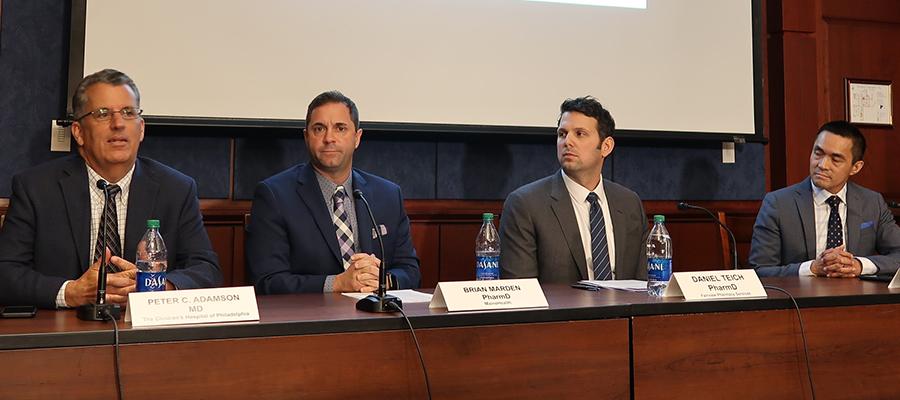
Pictured, from left to right: Peter Adamson, chair of the Children’s Oncology Group at the Children’s Hospital of Philadelphia; Brian Marden, chief pharmacy officer at MaineHealth Portland, ME; Daniel Teich, vice president of pharmacy purchasing and contracting at Fairview Pharmacy Services in Minneapolis, MN; and Edward Mariano, M.D., chief of anesthesiology and perioperative care service and associate chief of staff for inpatient surgical services at VA Palo Alto (Calif.) Health Care System, discuss drug shortages and their impact on patients.
Drug shortages threaten the quality of patient care, narrow treatment options and often result in the use of potentially less effective alternative medications, hospital and health system leaders said at a briefing today on Capitol Hill, urging Congress to pass the AHA-supported Mitigating Emergency Drug Shortages Act (S.2723).
Introduced last week by Sens. Susan Collins, R-Maine, and Tina Smith, D-Minn., the legislation would require manufacturers to disclose the root causes and expected duration of shortages, and develop contingency plans to ensure an ongoing supply, among other provisions.
“We need to get past the notion that this is a temporary problem that sometimes occurs when there’s a hurricane in Puerto Rico,” Collins said at the start of the briefing. “That can be a factor and indeed has been a factor, but this is a far more complicated problem with root causes that we need to address.”
More than 100 drugs are currently in short supply, presenting a major challenge for every segment of health care.
Peter Adamson, M.D., an oncologist at the Children’s Hospital of Philadelphia, spoke about the shortage of vincristine, a chemotherapy drug essential to the treatment of most pediatric cancers. Adamson said his hospital uses it to treat three out of four children with cancer.
“We had to tell families they couldn’t get it,” he said, describing difficult conversations with parents and family members. “The MEDS Act is an important next step.”
Edward Mariano, M.D., chief of anesthesiology and perioperative care services at the Department of Veteran Affairs’ VA Palo Alto (Calif.) Health Care System, underscored the need for providers to have the means to perform at their best.
“Not having the right drugs at the right time for our patients, it really forces us to use alternatives that may be less acceptable, if they exist at all,” Mariano said. “And this represents a form of moral injury that is a huge contributor to the epidemic of physician burnout. We need to consider this because we need a physician workforce that can fulfill its calling and take care of our population.”
Using alternative medications and treatments isn’t as simple as some think, said Daniel Teich, vice president of pharmacy purchasing and contracting for Fairview Pharmacy Services, part of Minneapolis-based Fairview Health Services.
“These products are carefully picked and embedded in our care plans to treat our patients in a thoughtful, careful clinical model,” Teich said. “And this disruption caused by these continuous drug shortages are a distraction from the real mission for caring and healing patients we serve.”
The AHA, American Society of Anesthesiologists, American Society of Clinical Oncology, American Society of Health-System Pharmacists, American Society for Parenteral and Enteral Nutrition, Children’s Hospital Association, Federation of American Hospitals, and Premier hosted the briefing.