

AHA Files 340B Complaint for Declaratory and Injunctive Relief Against HHS, HRSA

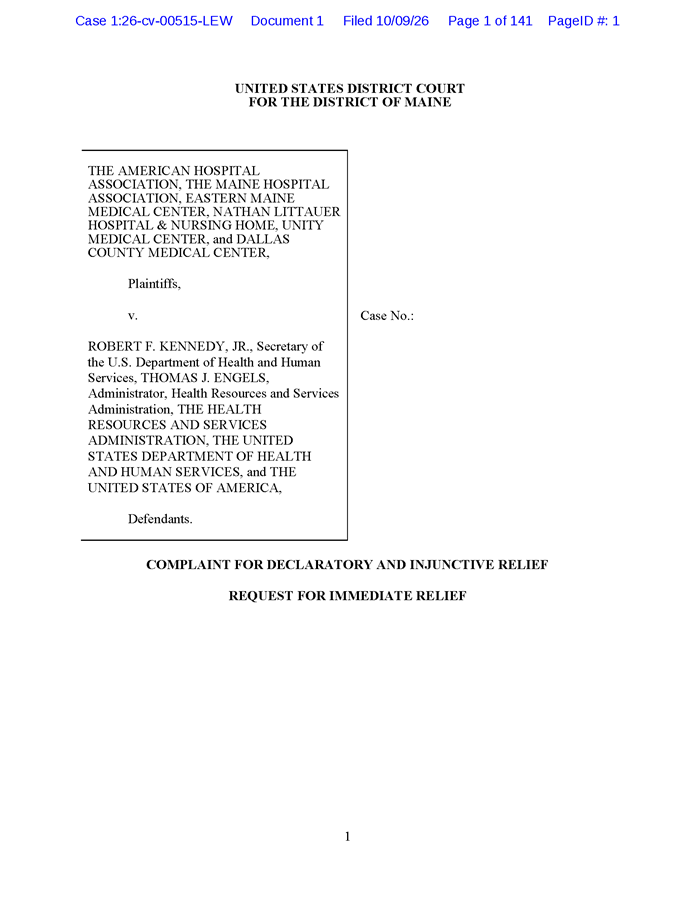
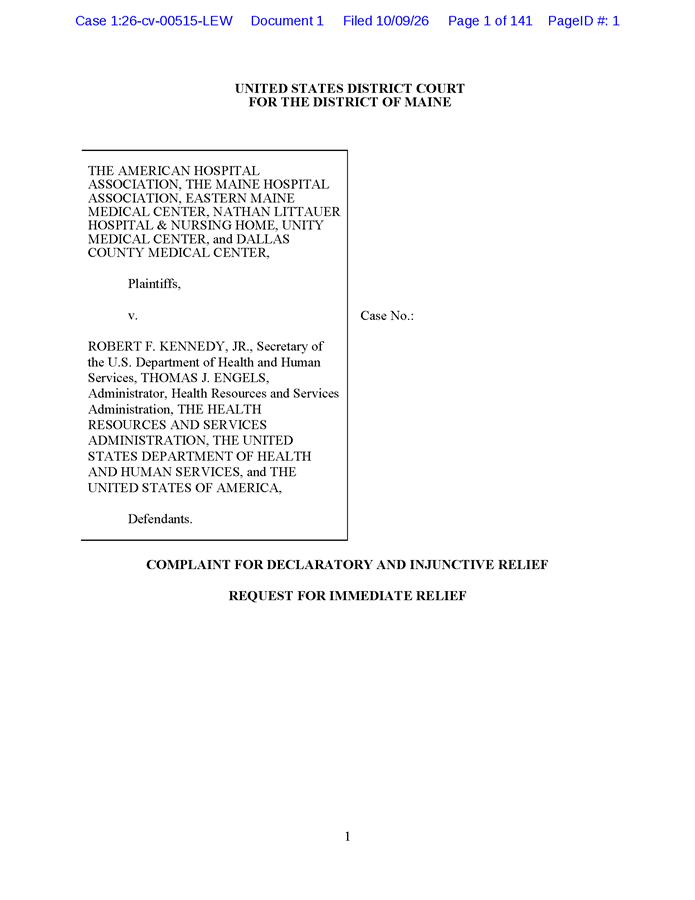
UNITED STATES DISTRICT COURT
FOR THE DISTRICT OF MAINE

THE AMERICAN HOSPITAL ASSOCIATION, THE MAINE HOSPITAL ASSOCIATION, EASTERN MAINE MEDICAL CENTER, NATHAN LITTAUER HOSPITAL & NURSING HOME, UNITY MEDICAL CENTER, and DALLAS COUNTY MEDICAL CENTER,

Plaintiffs,

v.

ROBERT F. KENNEDY, JR., Secretary of the U.S. Department of Health and Human Services, THOMAS J. ENGELS, Administrator, Health Resources and Services Administration, THE HEALTH RESOURCES AND SERVICES ADMINISTRATION, THE UNITED STATES DEPARTMENT OF HEALTH AND HUMAN SERVICES, and THE UNITED STATES OF AMERICA,

Defendants.

Case No. 26-cv-_____

COMPLAINT FOR DECLARATORY AND INJUNCTIVE RELIEF

REQUEST FOR IMMEDIATE RELIEF
Introduction

  1. Almost thirty-five years ago, Congress created a drug pricing program that is essential to safety-net healthcare providers. See Veterans Health Care Act of 1992, Pub. L. No. 102-585, § 602, 106 Stat. 4943, 4967–71 (1992), codified at § 340B, Public Health Service Act, 42 U.S.C. § 256b (1992). Now commonly known as the “340B Program,” it allows these providers to purchase certain outpatient medications at reduced cost and use the savings to ensure access to care, improve patient services, and reach America’s most vulnerable populations. See H.R. Rep. No. 102-384, pt. 2, at 12 (1992). As a unanimous Supreme Court explained a few years ago: “340B hospitals perform valuable services for low-income and rural communities but have to rely on limited federal funding for support.” Am. Hosp. Ass’n v. Becerra, 596 U.S. 724, 738 (2022).
  2. Since the 340B Program’s enactment, drug companies have been required “to provide discounts to safety-net hospitals at the time of sale.” Am. Hosp. Ass’n v. Kennedy, 164 F.4th 28, 31 (1st Cir. 2026) (“AHA II”) (emphasis removed). Requiring drug companies to offer discounted medications at the time of the sale, rather than as a delayed rebate, is known as an “upfront discount.” The Health Resources and Services Administration (“HRSA”), a component of the U.S. Department of Health and Human Services (“HHS”), is charged with administering the 340B Program. HRSA has long required this “upfront discount” approach because it both advances the overall purpose of the 340B statute and follows the specific statutory provision governing the mechanism for providing 340B discounts. Many covered entities that participate in the 340B Program operate on razor-thin (or negative) margins and limited cash-on-hand. They cannot afford the costs of paying upfront market prices for drugs without sacrificing the care they provide to patients.
  3. For years, drug companies unsuccessfully sought to replace the upfront discount mechanism with what they call a “rebate” mechanism. Such a change would inflict more than a billion dollars’ worth of annual costs on 340B hospitals. A rebate mechanism, for example, would impose massive administrative costs to submit, track, recover, reconcile, and dispute rebates. In addition, a rebate mechanism would inflict massive “float” costs by forcing 340B hospitals to use their limited cash-on-hand to “pay to the drug manufacturers upfront prices far exceeding the amounts that they actually owe—essentially functioning as an interest-free loan from the hospitals to the manufacturers—and then wait for a rebate.” Id. at 32.
  4. If 340B hospitals are forced to spend all this money on these administrative and “float” costs, the real-world consequences for patients and communities would be devastating: fewer free or discounted drugs for low-income patients; loss of critical medical services in underserved communities; fewer drugs readily available at rural hospitals; fewer staff available to care for patients; and more. Worse still, for some safety-net providers, these costs would prove too much to bear, forcing them to close their doors altogether. Therefore, as the First Circuit explained, “[a]lthough drug manufacturers have previously proposed a switch to a rebate model in which safety-net hospitals would pay higher upfront costs and receive reimbursements later, HHS has historically rejected such proposals as both inferior to Section 340B’s current upfront-discount model and disruptive to safety-net hospitals.” Id. at 31–32.
  5. But in August 2025, with no warning to safety-net hospitals, HRSA tried to fundamentally shift the way the 340B Program has operated for thirty-plus years. HRSA announced a “340B Rebate Model Pilot Program” (hereinafter the “Rebate Program” or “Program”) that would institute a rebate mechanism for ten of the costliest and most widely used drugs in the Medicare program. Given the crippling costs to caregivers in Maine and nationwide, Plaintiffs sued on the grounds that the government did not follow basic rules of administrative law. See Complaint, Am. Hosp. Ass’n v. Kennedy, No. 2:25-cv-600 (D. Me. Dec. 1, 2025), Dkt. No. 1.
  6. On December 29, 2025, Chief Judge Walker granted Plaintiffs’ request for a preliminary injunction three days before the Program was set to take effect. He held that, under the Administrative Procedure Act (“APA”), Defendants “failed to follow the APA’s basic blueprint in assembling the Rebate Program,” displayed “casual indifference to localized impacts” of the Rebate Program, failed to consider and reasonably explain the relevant costs, and ignored thirty years of reliance interests. Am. Hosp. Ass’n v. Kennedy, 820 F. Supp. 3d 30, 44–45 & n.5, 47 (D. Me. 2025) (“AHA I”). Judge Walker also found that Plaintiffs had demonstrated irreparable harm because, among other things, American Hospital Association (“AHA”) “members alone estimate $400 million in compliance costs, the downstream effect causing them to cut back services and suspend partnerships with drug distributors.” Id. at 46. The First Circuit denied an emergency appeal of Chief Judge Walker’s decision, describing the administrative record as “threadbare.” AHA II, 164 F.4th at 34. Following that decision, the government agreed to vacatur and remand, which this Court granted on February 10, 2026. See Order, Am. Hosp. Ass’n v. Kennedy, No. 2:25-cv-600 (D. Me. Feb. 10, 2026), Dkt. Nos. 114, 115.
  7. A mere week after remand, HRSA issued a new request for information seeking comments “to further evaluate the potential benefits and costs of a rebate model.” Request for Information: 340B Rebate Model Pilot Program, 91 Fed. Reg. 7,287, 7,289 (Feb. 17, 2026) (“RFI”). In late February 2026, HRSA published another notice, an information collection request submitted to the Office of Management and Budget (“OMB”), indicating that it anticipated expanding its contemplated Rebate Program to 25 of the costliest and most widely used drugs, more than doubling the scope of the first program. See Agency Information Collection Activities: 340B Rebate Model Pilot Program Application, Implementation, and Evaluation, OMB No. 0906-NEW, 91 Fed. Reg. 9,632, 9,632–33 (Feb. 26, 2026) (“February ICR”).
  8. In response, HRSA received over 2,400 comments, including 1,200 comments from 340B hospitals and other covered entities, and nearly 150 more from associations representing covered entities. These comments described in granular detail the catastrophic impact that a rebate mechanism would have on providers, patients, and communities. Commenters offered specific, facility-level data on the staggering administrative costs of a rebate mechanism, the new full-time employees (“FTEs”) hospitals would need to hire, the costs of “floating” hundreds of millions of dollars to drug companies, the valuable discounts hospitals would permanently lose under a rebate mechanism, the non-economic costs on patient care, and many other overlooked costs. They also warned that the timing could hardly be worse: in 2026 and 2027, hospitals will already be absorbing billions of dollars in adverse revenue impacts from the One Big Beautiful Bill Act (“OBBBA”), Pub. L. No. 119-21, and other federal policies, making those years an especially perilous time to impose billions of dollars in new costs.
  9. HRSA disregarded these warnings and data. On August 3, 2026, HRSA published a notice announcing its intent to launch its even larger “340B Rebate Model Pilot Program” that could now cover up to 25 drugs. See Notice Regarding 340B Rebate Model Pilot Program, 91 Fed. Reg. 48,883 (Aug. 3, 2026) (“Notice”). This new Rebate Program remains a “pilot” in name only. It applies to every 340B hospital and covered entity in America, regardless of geographic location, size, services offered, or any other distinguishing factor—totaling more than 15,000 covered entities and more than 49,000 sites by HRSA’s own estimate. Id. at 48,901. Participation by covered entities is compulsory to obtain statutorily owed discounts. By contrast, participation is voluntary for drug companies. Id. at 48,900 n.32. The so-called “pilot” also has no clear end date and, by the words it chose to describe the Program, HRSA seems to presume that it will last for more than one year: “[u]pon conclusion of the first year of Pilot operations, HRSA will publish an evaluation by April 30, 2028.” Id. at 48,901 (emphasis added).
  10. On October 1, 2026, HRSA announced the approval of ten drug companies’ rebate plans, covering a total of 18 drugs, to begin on January 1, 2027. HRSA, 340B Rebate Model Pilot Program, https://www.hrsa.gov/opa/340b-model-pilot-program (“HRSA Rebate Program Webpage”). By almost doubling the number of drugs covered under the Rebate Program, this so-called “pilot” will increase the costs of the Program as compared to last year and further reduce access to care. In fact, the October approvals increased the costs that covered entities will have to bear in ways the Notice itself did not contemplate. For example, the Notice offered repeated assurances that the drug companies’ plans will be consistent—that there will be no “manufacturer-specific” requirements or other variations. 91 Fed. Reg. at 48,893. But the approved plans reveal meaningful differences in what HRSA allowed each drug company to require—variations that will further increase covered entities’ costs and administrative burdens.
  11. HRSA’s second Rebate Program violates the “APA’s basic blueprint” as starkly as its first. AHA I, 820 F. Supp. 3d at 47. Most significantly, it contravenes the blackletter principle that an agency must accurately evaluate the costs and benefits of any regulation. “Consideration of cost reflects the understanding that reasonable regulation ordinarily requires paying attention to the advantages and the disadvantages of agency decisions.” Michigan v. EPA, 576 U.S. 743, 753 (2015). But even though the First Circuit recognized that a rebate mechanism would impose “significant costs” on covered entities, AHA II, 164 F.4th at 34, HRSA has again failed to reasonably consider “the costs and benefits associated with the regulation.” AHA I, 820 F. Supp. 3d at 44 (quoting Mexican Gulf Fishing Co. v. U.S. Dep’t of Com., 60 F.4th 956, 973 (5th Cir. 2023)).
  12. In particular, HRSA “unreasonably understated the costs of the Rule while unreasonably overstat[ing] the benefits,” Chamber of Com. of the U.S. v. FTC, 820 F. Supp. 3d 473, 491 (E.D. Tex. 2026) (internal quotation marks and citation omitted), and thus failed to “identify benefits that ‘bear a rational relationship to the . . . costs imposed.’” Id. (quoting Chamber of Com. of the U.S. v. SEC, 85 F.4th 760, 777 (5th Cir. 2023)). HRSA “did not even attempt to quantify the actual costs and purported benefits” of the Program, “much less perform a reasoned balancing.” Presidents’ All. on Higher Educ. & Immigr. v. U.S. Dep’t of Homeland Sec., 2026 WL 2690098, at *16 (D. Mass. Sept. 14, 2026). As a result, “the perfunctory and conclusory analysis performed by [HRSA] fails to satisfy even the bare minimum cost-benefit analysis the APA requires.” Id. “[W]ithout a reasoned cost-benefit analysis,” the Rebate Program “is arbitrary and capricious, and therefore violated the APA.” Id.
  13. HRSA’s “treatment of the costs” of the Rebate Program, in particular, “was egregiously flawed and incomplete.” Id. at *15. HRSA estimated that, under the 25-drug Rebate Program, covered entities will spend $537,222,270 every year just to submit claims data to drug companies. See Notice, 91 Fed. Reg. at 48,893 & n.20; Supporting Statement A, 340B Rebate Model Pilot Program Application, Implementation, and Evaluation Notice, OMB Control No. 0906-NEW (Aug. 4, 2026) (“Supporting Statement”). While staggering, HRSA’s half-billion-dollar figure covers only a single administrative burden—submitting claims data. It excludes the massive reconciliation, start-up, information-technology, vendor, training, audit, and dispute-resolution costs that hospitals will need to shoulder—many of which are equally significant, if not greater. The administrative record shows that the full operational costs will, conservatively, exceed $1 billion a year for 340B hospitals alone. Those hospitals are only approximately 18% of the 15,000 safety-net entities participating in the 340B Program, meaning the actual total cost is many multiples of HRSA’s $500 million-plus figure.
  14. HRSA’s half-billion-dollar calculation rests on the inexplicable assumption that this Rebate Program will require each facility to spend only five hours of pharmacist time per week to comply. But “[f]rankly, the [HRSA] staffing plan[/labor hour] number appears as if pulled from thin air.” Am. Fed’n of Gov’t Emps., AFL-CIO v. Trump, 2026 WL 2677331, at *17 (N.D. Cal. Sept. 11, 2026). Defendants’ labor-hour assumption originated back in 2025, before receiving a single comment, and they blindly stuck to the same approach this year. The only difference this year is that HRSA took its prior (erroneous and unsupported) labor-hour calculation and multiplied it by 2.5 to capture the 2.5 times as many drugs selected for inclusion in the new Program.
  15. To arrive at the same 5-hour-per-week result as before, HRSA ignored the avalanche of comments from covered entities demonstrating that they will have to hire full-time, 40-hour-per-week employees to comply with the new Rebate Program. HRSA never revisited or explained its labor-hour figure after receiving these comments, which showed with specific, hospital-level data that HRSA’s 5-hour-per-week estimate is wildly off the mark. Instead, HRSA dismissed those comments in a few conclusory sentences, asserting that it “continues to believe that the estimated burden reasonably reflects the average paperwork burden associated with the information collection,” even though it conceded in the next breath that “actual burden may vary.” Supporting Statement at 7. All the while, HRSA continued to hide what, if any, methodology or data lies behind its 5-hour-per-week assumption. Accordingly, HRSA failed to address the “important problem[s] the public could and did raise during the comment period,” Ohio v. EPA, 603 U.S. 279, 298 (2024), and failed to offer the “reasoned response” the law requires. Id. at 293; Motor Vehicle Mfrs. Ass’n of U.S., Inc. v. State Farm Mut. Auto. Ins. Co., 463 U.S. 29, 43 (1983). Put simply, HRSA’s approach to labor hours this time around is just as “fatal under the APA” as it was last year. AHA I, 820 F. Supp. 3d at 45, 47.
  16. HRSA’s treatment of several specific categories of additional costs starkly illustrates the deficiencies in Defendants’ decision-making and explanation.
    1. Many commenters informed HRSA that they would incur significant vendor and training costs under a rebate mechanism. HRSA brushed these costs aside by nonsensically arguing “the 340B Program has always entailed some level of compliance and operational cost.” 91 Fed. Reg. at 48,894. Just because covered entities have historically incurred certain costs under the “upfront discount” mechanism does not permit HRSA to write off (and refuse to even calculate) the added vendor and training costs associated with its new rebate mechanism. Indeed, HRSA recognized this in its initial February 2026 RFI, asking stakeholders to “[e]stimate the incremental administrative and operational costs your organization would incur under a 340B Model Rebate Pilot Program.” 91 Fed. Reg. at 7,289 (emphasis added). But by excluding vendor and training costs altogether, HRSA both underestimated costs and ignored a significant part of the problem.
    2. HRSA agreed with covered entities that there would be “legitimate” start-up costs. 91 Fed. Reg. at 48,893. But despite abundant record evidence that these costs are substantial (including covered entities’ firsthand experience with the first Rebate Program last fall), HRSA neither quantified them nor included them in its cost-benefit analysis. Instead, it dismissed start-up costs altogether because, in its view, they are “transitional” and “inherent to the adoption of a new operational approach.” Id. But labeling start-up costs as “transitional” does not analyze them, and it certainly is not a reasonable basis for excluding millions of dollars in start-up costs.
    3. The administrative record also contains unrebutted evidence of certain customary discounts that 340B hospitals and other covered entities will no longer be able to obtain under a Rebate Program. In particular, covered entities repeatedly explained that they will lose millions of dollars of prompt-pay and cost of goods sold (“COGS”) discounts. Yet HRSA did not factor these lost discounts into its cost calculations. In fact, the Notice briefly mentions COGS discounts when summarizing covered entities’ comments, 91 Fed. Reg. at 48,892, but never returns to them when performing its cost-benefit analysis. They, too, were excluded altogether. HRSA’s failure to further address and include this undisputed category of “Lost Discount Costs” was arbitrary and capricious. See Ohio v. EPA, 603 U.S. at 295 (“[A]wareness is not itself an explanation”).
    4. HRSA’s analysis of the costs associated with fronting hundreds of millions of dollars to drug companies (sometimes referred to in the comments as “float costs” or “acquisition costs”) is equally deficient. HRSA included no such costs in its cost-benefit analysis, stating that it “believes that the Pilot is unlikely to result in unstable cash flow for covered entities.” 91 Fed. Reg. at 48,894. But its entire support for this conclusion comes from two studies, both of which were self-interestedly funded by the drug industry and substantively “unpersuasive.” Bus. Roundtable v. SEC, 647 F.3d 1144, 1150–51 (D.C. Cir. 2011). In fact, HRSA inexplicably relied on a December 2025 study whose authors revised and increased their estimates of interest costs in April 2026 because some of the factual underpinnings of their previous work (on which HRSA relied) were incorrect. Moreover, these studies were concededly narrow. They did not address a host of realities that would make having to “float” hundreds of millions of dollars to drug companies even more expensive. These included risks of violating bond covenants, wholesaler escrow requirements, and the practical reality that not all claims would be rebated on time, thereby extending the “float” period beyond any programmatic guardrails. Though raised in many comments, HRSA never addressed these problems when dismissing “float costs” altogether.
  17. HRSA also irrationally disregarded non-economic costs to patients and communities. The Notice states, without elaboration, that its Program will not “materially impair covered entities’ . . . ability to furnish services to patients.” 91 Fed. Reg. at 48,899. Nowhere did HRSA acknowledge, as this Court did, the “downstream effect” that requiring covered entities to spend (at least) well over $500 million on claim-submissions will force them to “cut back services.” AHA I, 820 F. Supp. 3d at 46. Nor did HRSA grapple with the hundreds of covered-entity comments identifying in painstaking detail the specific service lines, community programs, drug price discounts, and operating hours that the Rebate Program will force them to cut. Cost “means more than dollars and cents.” Ky. Coal Ass’n, Inc. v. Tenn. Valley Auth., 804 F.3d 799, 802 (6th Cir. 2015). “[A]ny disadvantage could be termed a cost,” including “harms that regulation might do to human health.” Michigan, 576 U.S. at 752. But HRSA ignored those non-economic costs altogether.
  18. On the other side of the ledger, HRSA never quantified the benefits from its Rebate Program. It conceded that “there is no federal estimate of the financial extent of duplicate discounts in 340B.” 91 Fed. Reg. at 48,887. The only figures it included in the Notice parrot the drug companies’ assertions. Thus, HRSA’s entire analysis of program benefits was adopted without any critical examination and without acknowledging the wealth of contrary evidence that covered entities submitted demonstrating that the drug companies vastly overstate the number of duplicate discounts that currently exist.
  19. Moreover, even HRSA’s parroted discussion of duplicate discounts is irrational. For example, HRSA cited assertions by “[m]anufacturer commenters” that duplicate discounts “amounted to as much as $1.5 billion annually.” 91 Fed. Reg. at 48,887. But that figure encompasses all 340B drugs, not the 25 selected for the proposed Rebate Program, much less the 18 drugs approved to date. HRSA itself stated that the Program would cover “less than 5.5% of total 340B sales” if all 25 drugs were involved. Id. at 48,893. A quick back-of-the-napkin calculation (e.g., 5.5% of the $1.5 billion figure equals $82.5 million) suggests the maximum benefits would be limited, but HRSA offered no estimate of the Rebate Program’s actual deduplication benefit for this smaller set of drugs. Nor did it explain why it is reasonable to spend billions on administrative costs for what, at best, could amount to a fraction in savings. See Chamber of Com. of the U.S., 820 F. Supp. 3d at 489 (“[T]he FTC’s resource-savings argument is limited to a small subset of HSR filers, and the agency again fails to show how that limited benefit reasonably outweighs the significant costs on the thousands of other annual filers.”).
  20. HRSA’s evaluation of the Program’s benefits violates the APA many times over:
    1. HRSA itself never actually calculated benefits, instead choosing to uncritically adopt data submitted by the drug companies. E.g., Cboe Futures Exch., LLC v. SEC, 77 F.4th 971, 979 (D.C. Cir. 2023) (if an agency wants to rely on a regulated party’s analysis to support its decision, “it needed to critically review and adopt [the party’s] submissions or perform its own comparable analysis” (internal quotation marks omitted)).
    2. HRSA never actually identified how much the Rebate Program itself can or will incrementally correct the duplicate discount problem it is designed to address. This is a particularly important question since the rules of the Rebate Program affirmatively prevent drug companies from denying rebates even if they suspect a duplicate discount. E.g., Chamber of Com. of the U.S., 85 F.4th at 779 (“[T]he rule’s primary benefit—decreasing investor uncertainty about motivations underlying buybacks—is inadequately substantiated.”).
    3. HRSA never responded to comments explaining that the drug companies vastly overstate the duplicate discount problem and that, based on HRSA’s own audit data, duplicate discounts have decreased dramatically since 2018. See Genuine Parts Co. v. EPA, 890 F.3d 304, 312 (D.C. Cir. 2018) (an agency “cannot ignore evidence that undercuts its judgment; and it may not minimize such evidence without adequate explanation”).
    4. HRSA “inconsistently and opportunistically framed the costs and benefits of the rule,” Bus. Roundtable, 647 F.3d at 1148–49, by comparing the Program’s administrative and other costs to overall 340B Program-wide duplicate discounts rather than the incremental benefits of its 25-drug Rebate Program. E.g., Chamber of Com. of the U.S., 85 F.4th at 777 (an agency “cannot have it both ways” by embracing a premise when tallying benefits and rejecting it when tallying costs).
  21. Ultimately, the Notice follows a consistent, and telling, pattern. Again and again, covered entities “offered ample basis for the truth of their positions: their extensive knowledge and experience with” hospital operations under the 340B Program. Cath. Legal Immigr. Network, Inc. v. EOIR, 513 F. Supp. 3d 154, 174 (D.D.C. 2021). These covered entities are “intimately familiar with their budgets and resources and therefore have a unique capacity to estimate how” the Rebate Program “would upend their normal practices and would affect the number of [patients] they can serve.” Id. But HRSA flatly dismissed their comments and declared that it “anticipates,” “expects,” and “believes” the burdens will be small. 91 Fed. Reg. at 48,891, 48,893–95. By contrast, whenever drug companies and their vendors supplied assertions, HRSA uncritically adopted them as fact. That is precisely the kind of “unquestioning reliance” on a regulated party’s self-serving analysis that courts forbid. Susquehanna Int’l Grp., LLP v. SEC, 866 F.3d 442, 447 (D.C. Cir. 2017).
  22. HRSA’s treatment of reliance interests fares no better under the APA. Despite having previously “agree[d]” that covered entities’ reliance interests are “significant,” AHA II, 164 F.4th at 34, HRSA has now declared them unreasonable as a “matter of law,” 91 Fed. Reg. at 48,889. In its view, because the statute gives HRSA discretion to approve a rebate mechanism in certain circumstances, covered entities could not rely on thirty-three years of consistent practice and repeated agency endorsement of the upfront discount model. Under Supreme Court and First Circuit precedent, that reasoning fails as a matter of law. E.g., Dep’t of Homeland Sec. v. Regents of the Univ. of Cal., 591 U.S. 1, 30–32 (2020); Woonasquatucket River Watershed Council v. U.S. Dep’t of Agric., 186 F.4th 25, 44–46 (1st Cir. 2026).
  23. HRSA also failed to rationally consider obvious, less burdensome alternatives. This is particularly stunning because Defendants told the First Circuit last year that “[m]anufacturers have alternate means to deduplicate discounts,” Doc. 00118385034 at 8, No. 25-2236, Am. Hosp. Ass’n v. Kennedy (1st Cir. 2025), and said the same to the D.C. Circuit as recently as February 2026. Doc. 2158427 at 2, No. 25-5177, Novartis Pharms. Corp. v. Kennedy (D.C. Cir. 2025). Yet the Notice rejects a neutral data clearinghouse in a single paragraph, 91 Fed. Reg. at 48,900, even as its sister agency, the Centers for Medicare and Medicaid Services (“CMS”), opened a similar clearinghouse on October 1, 2026, the same day HRSA announced the drug company application approvals for the Rebate Program. In addition, HRSA rejected every alternative that preserves upfront discounts based on the self-justifying logic that such alternatives “would not inform whether rebates are an efficient means” of providing 340B pricing. Id. at 48,890. It also ignored altogether the AHA’s proposals that drug companies publish 340B and maximum fair prices prospectively, that drug companies fund the costs of any “test” they want to run, and that any pilot be deferred until after safety-net hospitals absorb the $68 billion revenue impact of the OBBBA.
  24. Most fundamentally, HRSA evaluated the Rebate Program under the wrong legal standard. Congress committed the choice of pricing mechanism to Defendants with an express instruction: use “the mechanism that is the most effective and most efficient from the standpoint of each type of ‘covered entity.’” H.R. Rep. No. 102-384, pt. 2, at 16 (1992) (emphasis added). HRSA quoted the “standpoint” standard in several legal filings over the last two years, and it applied that standard previously to another type of covered entity. See infra ¶¶ 51, 54–56. The D.C. Circuit repeatedly emphasized that standard just days before HRSA issued its Notice. Novartis Pharms. Corp. v. Kennedy, 182 F.4th 1027, 1030–31 (D.C. Cir. 2026). HRSA’s Notice itself even quotes this “standpoint” standard. See 91 Fed. Reg. at 48,884–85.
  25. But HRSA never applied that “standpoint” standard. Instead, HRSA announced that it “must balance” covered entities’ interests against “program integrity” and “competing policy concerns,” id. at 48,887–88—a standard of the agency’s own invention that elevates a “subsidiary” nonstatutory goal over the particular statutory purpose made explicit by Congress, see PhRMA v. Frey, 2026 WL 184504, at *9 n.10 (D. Me. Jan. 23, 2026). The reason is obvious: a payment mechanism that imposes at least half a billion dollars—and, more realistically, billions of dollars—in annual costs on safety-net providers is neither effective nor efficient from the standpoint of the covered entities. The Rebate Program was not based on the relevant factors and was “unmoored from the purposes and concerns” of the relevant law. Judulang v. Holder, 565 U.S. 42, 64 (2011); Gulluni v. Levy, 85 F.4th 76, 82 (1st Cir. 2023).
  26. Thousands of 340B hospitals and other 340B providers face crushing costs and consequences should the Rebate Program go into effect as intended on January 1, 2027, jeopardizing their ability to provide care to the most vulnerable patients in their communities. Many of these safety-net hospitals provide the only healthcare services in their areas. For covered entities to continue providing their current levels of care to their patients, this Court must quickly enjoin this unlawful, unnecessary, and unexplained program that jeopardizes one of the key pillars of U.S. healthcare. The Rebate Program is arbitrary and capricious and must be set aside.

View the full complaint.

AHA v. Kennedy 340B Complaint for Declaratory and Injunctive Relief page 1.