

Letters/Comments
April 27, 2026
The Honorable Thomas J. Engels
Administrator
Health Resources and Services Administration
U.S. Department Health and Human Services
5600 Fishers Lane
Rockville, MD 20852
Re: Request for HRSA Action on Drug Company 340B Data Policies
Dear Administrator Engels:
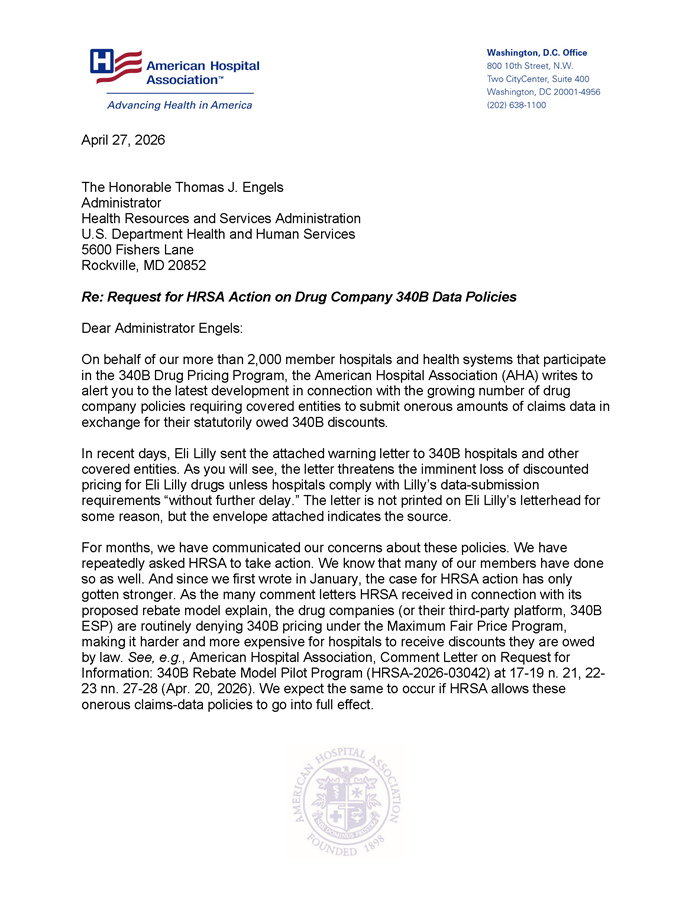
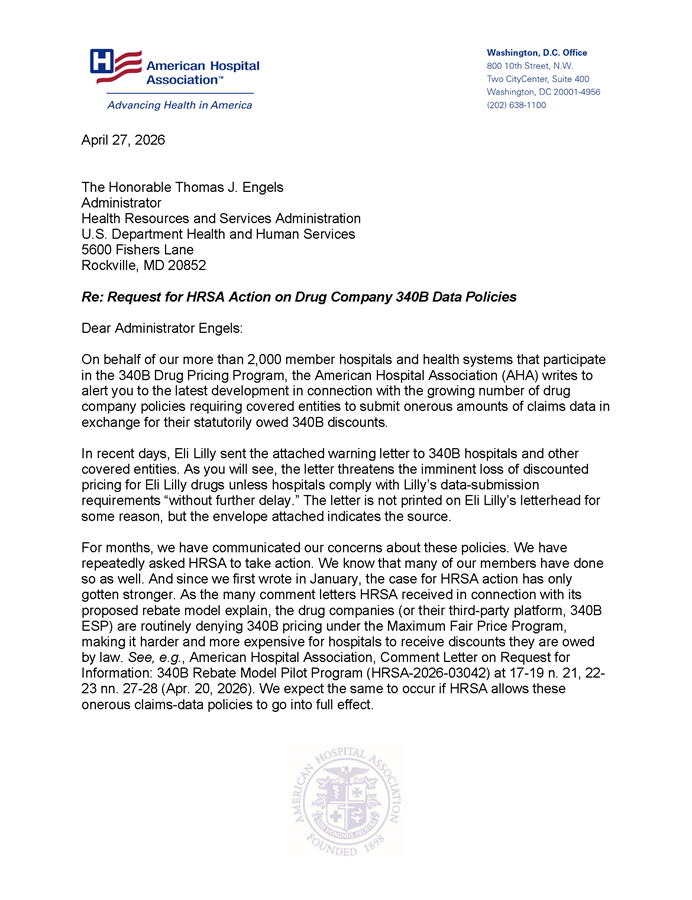
On behalf of our more than 2,000 member hospitals and health systems that participate in the 340B Drug Pricing Program, the American Hospital Association (AHA) writes to alert you to the latest development in connection with the growing number of drug company policies requiring covered entities to submit onerous amounts of claims data in exchange for their statutorily owed 340B discounts.
In recent days, Eli Lilly sent the attached warning letter to 340B hospitals and other covered entities. As you will see, the letter threatens the imminent loss of discounted pricing for Eli Lilly drugs unless hospitals comply with Lilly’s data-submission requirements “without further delay.” The letter is not printed on Eli Lilly’s letterhead for some reason, but the envelope attached indicates the source.
For months, we have communicated our concerns about these policies. We have repeatedly asked HRSA to take action. We know that many of our members have done so as well. And since we first wrote in January, the case for HRSA action has only gotten stronger. As the many comment letters HRSA received in connection with its proposed rebate model explain, the drug companies (or their third-party platform, 340B ESP) are routinely denying 340B pricing under the Maximum Fair Price Program, making it harder and more expensive for hospitals to receive discounts they are owed by law. See, e.g., American Hospital Association, Comment Letter on Request for Information: 340B Rebate Model Pilot Program (HRSA-2026-03042) at 17-19 n. 21, 22-23 nn. 27-28 (Apr. 20, 2026). We expect the same to occur if HRSA allows these onerous claims-data policies to go into full effect.
Unfortunately, we are not aware of any action that HRSA has taken to address these unlawful drug company claims-data policies, even as more and more companies have announced policies similar to Lilly’s. HRSA’s inaction here stands in stark contrast to the speed with which it acted in 2024 when the drug companies announced their unlawful rebate policies. This has raised serious questions within the regulated community about whether HRSA has now tacitly blessed these unilateral claims-data policies.
Meanwhile, our members tell us that these drug company policies are forcing them to operate under serious cost, chaos and confusion. And the longer this situation goes on without any response from HRSA, 340B hospitals will be unsure whether they should not comply with these policies because HRSA might one day step in, or whether they should incur hundreds of thousands of dollars in wasteful compliance costs because they cannot count on HRSA to act.
We therefore once again respectfully request that HRSA take action to prohibit these onerous claims-data policies. As we explained in our January 26 letter, HRSA has the legal authority to issue civil monetary penalties to enforce the 340B statute’s plain requirements. But at the very least, if HRSA is not going to take action, it should announce and explain its decision to provide greater clarity to the regulated community.
The AHA stands ready to work with you to protect the fairness and integrity of the 340B Program. We appreciate your attention to this matter, and respectfully request an opportunity to meet with you to discuss HRSA’s position on these claims-data demands. If you have any questions, please contact me or Devin Gerzof, AHA’s executive director of executive branch relations and federal relations, at dgerzof@aha.org.
Sincerely,
/s/
Chad Golder
General Counsel & Secretary