

Looking Ahead to 2026 and Continuing the Journey Toward Improving Health Outcomes for All
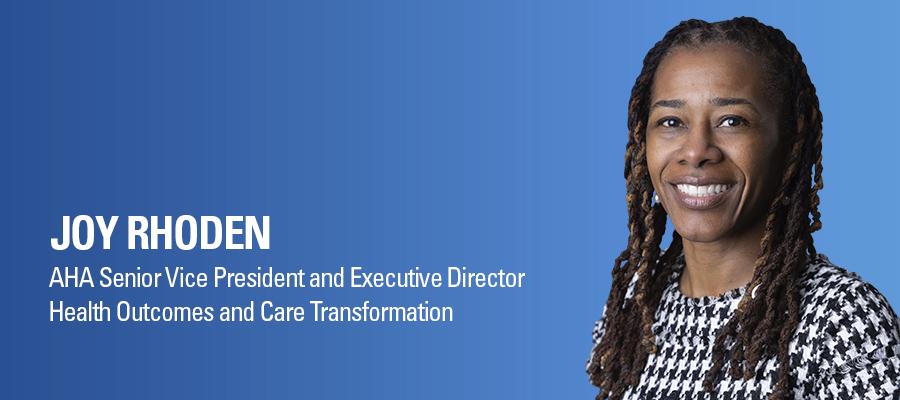
Hannah Nesich, AHA senior communications specialist, recently sat down with Joy Rhoden, AHA senior vice president and executive director, health outcomes and care transformation, to talk about what’s ahead in 2026.
Question: Looking ahead to 2026, what are some of the AHA’s top strategic goals for supporting our members as they work to improve health for all?
Rhoden: Looking ahead, we will develop content and offerings around: reducing health disparities; maternal and child health; upstream drivers of health, including social, structural and economic; prevention and wellness; and chronic diseases and care delivery transformation. These topics are highly relevant as we empower hospital and health system leaders to deploy strategies and tactics to address challenges that sometimes feel intractable in health care. We will provide thought leadership and knowledge-sharing opportunities, leveraging existing and new modalities to deliver content — blogs, podcasts, speaking engagements and in-person convenings, such as an annual conference and customized topic-based summits. And, because we know that being nimble is important in our work, we will maintain capacity for pivots and expansion into new areas such as artificial intelligence and data science.
Question: Health literacy plays a critical role in improving patient engagement. How is your team working to help hospitals improve health literacy?
Rhoden: I think health literacy is an important component of patient engagement. How does a patient fully experience care if they're not tracking with the language that health care uses? Individuals should be positioned to make informed care decisions based on receiving good information from their providers, having the opportunity to sit with, make sense of, and then ask probing questions.
AHA members have shared with us what they are doing to support health literacy. One approach that some members use as a patient engagement/education strategy is the “teach back method.” The idea is that the patient tells the provider, “Here's what I just heard you say ...” and the provider can clarify, so they're making sure they're both leaving that encounter confident they understood each other.
It also addresses the power dynamics in the provider-patient relationship. If the provider has a mindset of, “I am here to be taught,” “I want to hear what is important to my patient,” that is so powerful. It means the patient has a sense of ownership in their own care. Creating the environment and fostering a culture where these tactics and values are emphasized — and empowering patients as partners in their care — is really the goal.
In May 2026, the AHA kicks off its inaugural Healthier Together conference. What emerging themes or challenges are shaping the conference agenda and what can attendees expect to see?
Rhoden: This May, we will bring together leaders from hospitals and health systems, public health agencies, community organizations and other stakeholders to learn about data-driven strategies, collaborative solutions and innovative approaches to reduce disparities in health outcomes.
One of our plenary sessions is going to be on AI. It's a great opportunity to talk about how to leverage AI to augment care and address population health needs. And, more specifically, to help health systems use predictive analytics to understand their patient population and anticipate who might be at greater risk for return emergency department visits and hospitalizations.
Any final thoughts?
Rhoden: I’ve enjoyed doing this end-of-year blog the past three years. My priority, moving forward, is ensuring that in a resource-constrained environment for our field, we are equipping hospital and health system leaders with tools and strategies to address health disparities. The AHA has done important work on this topic in the past, and the new Division of Health Outcomes and Care Transformation looks forward to continuing it in the future. For me and the AHA, this is about changing lives and changing the trajectory for generations to come.