

Nickels: Seize This Opportunity to Tell Your Story
Watch the video
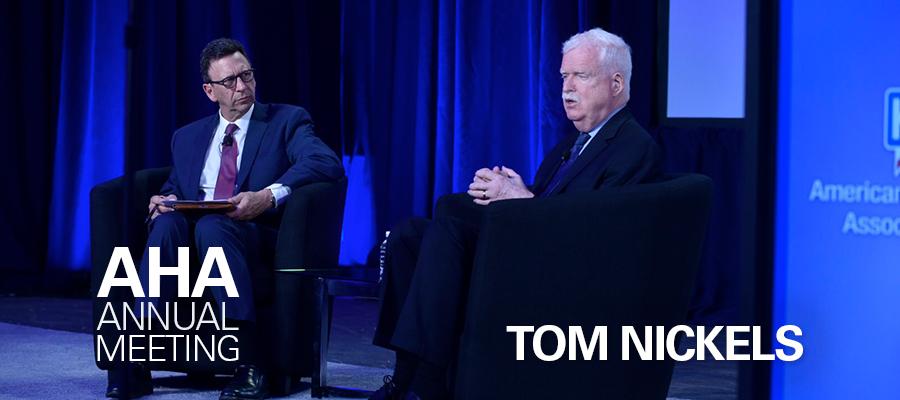
The timing of the AHA Annual Membership Meeting presents a “real opportunity to talk with your members of Congress about what you are doing back home,” specifically how hospitals are improving value and affordability, coping with escalating drug prices and working at the front lines of the opioid epidemic, AHA Executive Vice President Tom Nickels said today in a conversation with Frank Sesno, former anchor and Washington bureau chief, CNN, and director of the George Washington University School of Media and Public Affairs.
In a wide-ranging talk, Nickels and Sesno discussed how Congress is working to pass bipartisan, bicameral opioid legislation to address the epidemic. Nickels said he expects the final legislation, which could come as early as this summer, to include incentives to develop and test non-addictive alternatives to opioids, grants to provide more treatment, mechanisms to increase capacity to treat those with substance use disorder, and, hopefully, allow better information sharing among providers to ensure patients receive the safest, most appropriate care. Several Congressional committees continue to hold hearings and markup legislation this month to address the epidemic.
Sesno and Nickels also discussed rising drug prices and the impact on patients and hospitals and health systems. Drug prices “are going up astronomically...for everyone, and Congress is paying attention to this,” Nickels said. President Trump, who is expected to make an announcement on actions to address rising drug prices this week, “has said some very powerful things about his concern about what the drug industry is doing about pricing,” he said, noting that AHA continues to work with the administration on steps to address rising drug prices. Nickels also added that the 340B drug savings program “is an important program that needs to be protected.”
[For additional highlights from the AHA Annual Membership meeting, click here.]
On the topic of the changing face of rural health care, Nickels pointed to the work of the AHA Task Force on Ensuring Access in Vulnerable Communities and an AHA-supported bill – the Rural Emergency Medical Center Act of 2018 – introduced today by Reps. Lynn Jenkins (R-KS), Ron Kind (D-WI) and Terri Sewell (D-AL) that would create a new Medicare facility designation to help rural communities maintain access to essential emergency and outpatient services for patients.
Congress understands the challenges in rural America and the need to “do something to prop up a number of entities,” including hospitals, Nickels said. However, health care may look different in different communities. AHA is working on legislation, and today’s bill is one example, “to set up different kinds of entities for rural America. It doesn’t have to be a full-blown hospital,” he said citing different models. He also pointed to AHA’s efforts to increase funding for rural broadband.
Other topics discussed included the mid-term elections, potential action on entitlement reform in the next Congress, veterans’ health care, trends in value-based care and further efforts to reduce the regulatory burden on hospitals and health systems.
In the recent proposed rule for Medicare inpatient payment for fiscal year 2019, the administration is “clearly making strides” on relieving burdens related to electronic health records and quality measure reporting, Nickels said.