

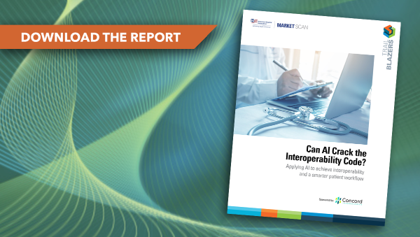
Applying AI to Achieve Interoperability and a Smarter Patient Workflow
New Trailblazer Report
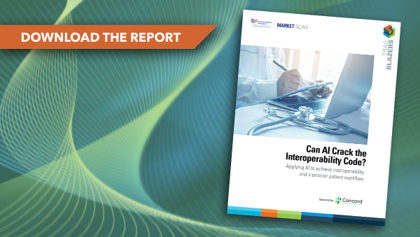
AI tools can support improved interoperability. Evidence supports the growing sentiment that AI can deliver not just incremental but substantial improvements in interoperability in both clinical and administrative settings.
Bridging the Health Data Interoperability Gap with AI
A new AHA Market Scan Trailblazers report, sponsored by Concord Technologies, examines how AI — with its ability to quickly recognize patterns, contextualize data and extract relevant information — can significantly streamline the processing of incoming documents and messages.
AI can reduce the human and information system effort required to review and process high volumes of structured and unstructured data. The technology can extract data points such as patient identifiers, medical record numbers, test orders and ICD codes and route information directly into electronic health records (EHRs) and workflow management systems — with reported results suggesting accuracy rates exceeding 90%.
Enhancing Operations with AI: Real-world Examples
A case study focused on WakeMed, a non-profit health system based in Raleigh, North Carolina, demonstrates the real-world impact of AI. WakeMed is leveraging the Concord Connect™ platform and Concord’s Practical AI™ approach to patient information processing to enhance operations in its contact center, which is frequently patients’ first touchpoint with the health system.
The integrated offering WakeMed has implemented from Concord facilitates straight-through processing of patient information across departmental workflows via secure information exchange, clinical data processing and flexible interoperability tools (EHR connectors and built-in APIs). The provider expects AI to reduce processing time for millions of incoming faxes, allowing staff members to spend more time supporting patients.
Additionally, the report touches on how North Shore Community Health, a Federally Qualified Health Center in Salem, Massachusetts, overcame a common barrier to AI adoption: convincing staff that AI tools were reliable enough to transform work processes. North Shore began with a common pain point (referrals), and AI adoption accelerated once employees saw how much easier that process became thanks to the new technology. Download the full report »


Related Resources
AHA Center for Health Innovation Market Scan
AHA Center for Health Innovation Market Scan