

PAM Health U.S. Post-Acute Care Case Study
Post-Acute Care CARE (PAC) | Case Study
About PAM Health
 PAM Health is a provider of long-term acute care, inpatient rehabilitation and behavioral health serving over 70 communities across the country for more than 20 years. Across its system, PAM Health has 25 long-term acute care hospitals (LTCHs) in Florida, Louisiana, Massachusetts, Nevada, Oklahoma, Pennsylvania and Texas. PAM Health is committed to providing high-quality patient care that restores lives.
Patients treated at PAM Health’s LTCHs are often facing life-threatening illness and injuries and require extended periods of specialized, intensive hospital-level care. These patients are covered by a mix of payers, with roughly 45% covered by traditional Medicare, 18% covered by Medicare Advantage (MA), 13% covered by Medicaid and 24% covered by commercial insurers.
The LTCH Care PAM Health Provides LTCHs are uniquely specialized in providing care to medically complex patients. PAM Health’s LTCH patients typically arrive from an acute care hospital’s intensive care unit (ICU) and have conditions such as multiple trauma, sepsis, severe wounds, recent organ transplantation or acute respiratory failure. Many patients also require ventilation to breathe. PAM Health’s LTCHs are fully licensed, specialized hospitals. The highly trained and specialized workforce
provides 24/7 hospital-level care, including nursing, respiratory therapy and daily physician oversight from both internal medicine and specialty physicians.
LTCH Patient Profile
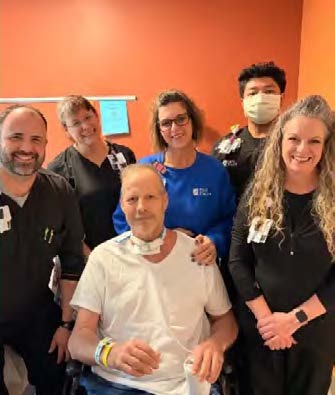 Anthony Upton was shot 11 times, suffering severe injuries to his chest, neck and hand. After receiving initial care in an acute care hospital, Mr. Upton was transferred to the long-term acute care unit at PAM Health Specialty Hospital of Miamisburg to receive the intensive, advanced care he needed to heal.
- Upon arrival, all 11 of Mr. Upton’s gunshot wounds were in critical condition, including a failing flap on one of his wounds that needed to be urgently addressed. PAM Health’s wound care team was able to provide the expert care he needed, and by discharge, all his wounds were healed.
- Mr. Upton required ventilator support to breathe and was debilitated and cognitively impaired when he arrived. PAM Health’s respiratory and rehabilitation specialists were integral in supporting Mr. Upton’s recovery and progress, helping him improve strength function, alertness and breathing as well as help him begin talking and eating again.
Complex and critically ill and injured patients like Mr. Upton rely on LTCHs to regain their health and thrive. Because of the high-quality care received at PAM Health’s LTCH, he is now excited to “get out and just live!” Read Anthony Upton's full success story.
PAM Health has also prioritized installing CT scanners, hyperbaric chambers, laboratories and other services at its LTCH locations to ensure they can provide the high level of care their patient population needs. Additionally, PAM LTCHs have onsite physical, occupational and speech therapists who work with appropriate patients to improve strength, confidence and functionality. Rehabilitation can facilitate a direct discharge home bypassing the need for additional inpatient care.
Additionally, PAM LTCHs have onsite physical, occupational and speech therapists who work with appropriate patients to improve strength, confidence and functionality. Rehabilitation can facilitate a direct discharge home bypassing the need for additional inpatient care.
PAM Health encourages patients and their families to be involved in their treatment plan from admission to post-discharge and strives to educate them for success in their recovery.
Without LTCHs, these patients would likely remain hospitalized in an ICU for long periods of time, straining the capacity of acute care hospitals, which have a limited number of ICU beds. Ensuring access to LTCHs not only helps patients recover and regain their health, but it also helps reduce patient length of stay and alleviate congestion in the acute care setting.
Medicare Advantage Policies Limit Patient Access to LTCH Care
Patients covered by MA plans often face barriers in accessing LTCH care, particularly due to MA plans’ heavy use of prior authorization, which can cause delays in much needed and timely care. With more than 34.1 million Americans enrolled in a MA plan, and enrollment growing, this is an issue that impacts patients in every community nationwide.
At PAM Health, LTCH admission is often delayed because of MA plans’ prior authorization requirements. Additionally, plans have limited the number of days patients can stay in an LTCH — regardless of their health condition or stage of recovery. For example, a patient may be approved for 7-10 days of care and then need to seek a second prior authorization to continue receiving care — a practice that can cause gaps in care and treatment.
On top of harming patient access, MA plans’ overuse of prior authorization has taken providers away from what they should be focusing on: treating patients. MA insurers processed 52.8 million prior authorization requests in 2024, a stunning 42.3% increase since 2019, according to the Kaiser Family Foundation. And 7.7% of these requests were at least partially denied. Of the prior authorization requests appealed, nearly 81% of the appeals were at least partially successful. The administrative burden has become so significant that PAM Health now has a team of 15 employees solely dedicated to appealing MA prior authorization denials.
Challenges Posed Under Medicare’s LTCH PPS
In addition to the pressures LTCHs face under MA, certain policies under Traditional Medicare also pose challenges, underscoring the need for prospective payment system (PPS) reforms.
Under the current LTCH PPS, a dual-rate payment system requires Medicare beneficiaries to meet certain criteria to qualify for the full payment. These criteria are so narrowly defined that Medicare will not pay the full LTCH rate for some patients, even though the patient may be a highly complex case, presenting with multiple comorbidities, and requiring the longer-term, intensive, around-the-clock care. The dual-rate payment system also creates a barrier for patients seeking care in rural areas. Medicare will not pay the LTCH rate for a patient transferred from a critical access hospital, even if that patient meets all other criteria. These restrictions have prevented patients from being transferred to PAM Health directly, where they could receive more appropriate care, ultimately raising costs to the health care system and reducing efficiency.
For a facility to qualify for Medicare payment as an LTCH, its patients must average a stay of at least 25 days in that LTCH. Failure to achieve this standard results in a facility losing its LTCH status and no longer being paid the LTCH rate for the costly, long-term care its patients require. This 25-day standard has been in effect since 1983, when Medicare recognized LTCHs as providing intensive care to the sickest patients. Since that time, health care technology and innovation have exploded, leading to countless improvements in the delivery of care that have enabled providers to treat many of their patients more efficiently, in less time and at less cost. The average length of stay (ALOS) requirement should be modernized so LTCHs like PAM Health can advance care and move patients appropriately through the healthcare continuum.
Medicare policy factors further impacting LTCH operations include:
- Current LTCH PPS also relies on the same diagnosis-related groups (DRGs) used in the inpatient PPS, resulting in underpayment for the highest-acuity cases.
- Inflation adjustments have failed to keep pace with the rising costs of operating LTCHs.
- As the restrictive LTCH criteria has dramatically reduced the number of patients for whom Medicare will pay an appropriate LTCH rate, LTCHs have had to absorb tens of thousands of additional dollars in losses per patient before receiving additional reimbursement.
Policy Solutions to Protect LTCHs
LTCHs are unique and clinically specialized, serving some of the sickest, most complex patients in the nation. However, LTCHs are facing many challenges that policymakers must address to ensure the long-term stability of these important sites of care.
Reforms policymakers should consider include:
- Expanding the payment criteria for LTCHs to admit patients to ensure patients can be moved to the appropriate setting of care when needed.
- Modernizing rules and oversight to help ensure that MA plans better serve beneficiaries, providers and taxpayers.
- Reforming prior authorization requirements to ensure plans provide timely and accurate decisions that admit patients to LTCHs when medically appropriate.
- Enabling critical access hospitals to directly transfer patients to LTCHs to lower costs and improve efficiency.
Post-Acute Care (PAC): Case Studies
Key Resources
Related Resources
Letters/Comments
AHA Center for Health Innovation Market Scan