

4 Best Practices for Community Health Improvement
Across the country, hospitals and health systems are striving to improve community health through collaboration. The American Hospital Association recently honored five of those organizations by naming them recipients of this year’s Dick Davidson NOVA Awards.
The 2026 winners were announced at the AHA Healthier Together Conference in Dallas in May. These AHA members exemplify how hospitals can play a vital role in improving the health of their surrounding communities.
Here are some insights and best practices for promoting better health outcomes from the programs that earned recognition this year.
 1 | Care coordination can help justice-involved youth chart a new course.
In 2017, Ann & Robert H. Lurie Children’s Hospital of Chicago collaborated with community partners to create the Juvenile Justice Collaborative (JJC), which helps youth arrested for serious misdemeanors or non-violent felonies change direction and avoid future trouble. Approximately 73% of enrollees complete the JJC program, and 89% of graduates had their charges dropped. Additionally, only 18% of program participants received a new charge within 12 months, compared to 28% of a matched comparison group.
Lurie Children's and its community partners that form the JJC — which includes 13 youth service providers, the Illinois Collaboration on Youth and an external care coordination hub — achieved these results with teamwork and care coordination. The Chicago children’s hospital serves as the JJC “partnership steward” and contributes child development expertise through Strengthening Chicago’s Youth, a violence prevention program at the Patrick M. Magoon Institute for Healthy Communities.
After receiving a referral from the Cook County state’s attorney or the Juvenile Probation Department, JJC care coordinators use the Child and Adolescent Needs and Strengths assessment to identify appropriate interventions (e.g., behavioral health treatment or help with basic needs like groceries) to meet the youth’s current needs and support their aspirations. For those exposed to violence, the program has built-in victim support services, and coordinators can also develop family care plans.
Care coordination focused on social services is the defining trait of the JJC, and Lurie Children’s modeled the program’s wraparound services after its processes for managing patients’ complex needs.
“The idea was for us to take everything we know about care coordination from a clinical sense and see if we could apply that to a different population, which was justice-involved youth,” said Mary Kate Daly, senior vice president and chief of community health at Lurie Children’s.
 2 | Telemedicine can expand access to critical pediatric mental health services.
Children’s of Alabama in Birmingham launched Pediatric Access to Telemental Health Services (PATHS) in 2019 to address low child-psychiatrist-to-population ratios in the region and rising rates of depression, anxiety and behavioral challenges among young people. Since the program’s debut, it has facilitated more than 2,100 telemedicine sessions and conducted behavioral health training for more than 1,200 personnel in school systems across the state.
PATHS partners with the University of Alabama at Birmingham and the Alabama Department of Mental Health. Its main elements include direct telemedicine services delivered via secure connections at primary care providers’ offices; Project ECHO, which provides biweekly telementoring for providers; and a consultation line that enrolled providers can call for real-time diagnostic and treatment guidance from psychologists, psychiatrists and social workers.
Since its launch, PATHS has facilitated more than 2,000 consultations with primary care providers across Alabama, allowing patients with mild to moderate conditions to receive behavioral healthcare in their primary care offices. The program also connects community agencies, schools and physician practices with resources and educational opportunities (e.g., PATHS received grant funding for the purpose of training rural community therapists in Parent-Child Interaction Therapy).
“I’m amazed daily at the work that’s being done in our state and the willingness of our providers to do everything they can to support families,” said PATHS Director Margo Harwell.
 3 | Community partnerships can improve outcomes for patients experiencing homelessness.
Two of this year’s NOVA Award winners are tackling one of healthcare's most persistent challenges: homelessness. Denver Health is a safety-net hospital in a metro area where nearly 1 in 5 hospitalized adults are unhoused. The health system’s Housing Outreach, Partnerships and Engagement (HOPE) program leverages a hospital-based partnership model to ensure patients have a safe place to go after discharge. Thanks to the program, the average hospital length of stay for patients experiencing homelessness dropped from 11 days in 2022 to eight days in 2025.
Denver Health staff collaborate with housing and homelessness-response partners to assist unhoused patients. HOPE proactively identifies patients in need using data from the Metro Denver Homeless Initiative, and the health system funds a portion of the recuperative care beds available through the Colorado Coalition for the Homeless. Additionally, the provider partnered with the Denver Housing Authority in 2023 to launch the 655 Broadway Transitional Housing Program, making 14 apartments with supportive services available for older or disabled unhoused patients.
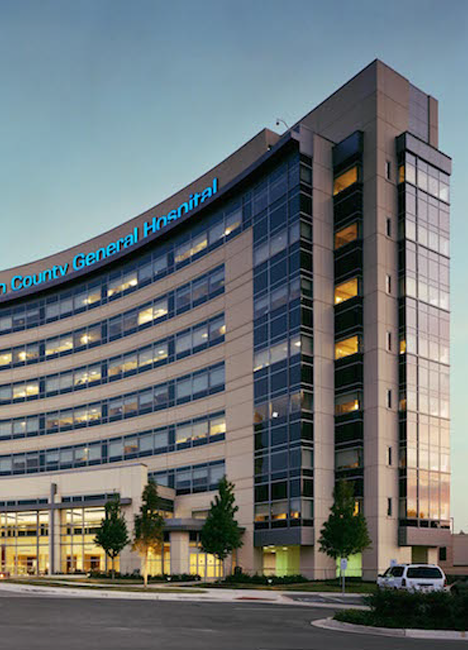 In rural Tennessee, Jackson-Madison County General Hospital (JMCGH) — the flagship safety-net institution of Jackson-based West Tennessee Healthcare — helps unhoused patients through the 25-year-old Collaborating to Address Homelessness program. JMCGH leads the initiative, which includes 30 cross-sector agencies that constitute the area’s Continuum of Care as designated by the federal Department of Housing and Urban Development (HUD). Between 2007 and 2024, the unhoused population decreased by almost 70% in the program’s service area.
The collaboration achieved those results through strategies such as distributing 4-by-6-inch neon Community Connection Cards, which provide information about services across 23 counties. Additionally, eight housing navigators focus on prevention, street outreach, case management and follow-up care. JMCGH also offers free grant-writing services to its partners.
“We want to take care of you beyond the four walls of this hospital to the extent we can,” said West Tennessee Healthcare President and CEO Tina Prescott, “and hope that we are able to continue to do that through innovative programs like this.”
 4 | Addressing non-medical needs can lead to less time in the hospital.
The Memorial Regional Hospital in Hollywood, Florida reduced emergency department visits by almost 30% and readmissions by 28% in two years with The Community Helping to Uplift and Bounce Back (HUB), a program that connects patients in need with services like utility-assistance programs and food pantries. The HUB helps patients with multiple needs through intensive case management.
Before the HUB’s launch in August 2023, hospital case managers referred patients to resources but had no way to know if they actually accessed the services. To solve that issue, Tim Curtin, vice president of community services, designated four of the provider’s most experienced case managers as “mobile connectors” who guide patients and walk beside them before making warm handoffs. For example, the HUB helped coordinate groceries, school resources and utility-assistance for the family of a 13-year-old patient who had undergone orthopedic surgery, supporting recovery without hospital readmission.
“Everyone’s a little different,” Curtin said. “But The HUB really brings that human element rather than just giving them a flier or guide to resources and saying, ‘Good luck, hope you make it there.’”
Download the 2026 AHA Dick Davidson Award winners booklet for more information about these AHA members and their community health improvement efforts.



Related Resources
AHA Center for Health Innovation Market Scan
AHA Center for Health Innovation Market Scan
Case Studies
Issue Landing Page