

Advancing Health Podcast
Supporting Victims and Communities of Mass Violence Incidents
Supporting Victims and Communities of Mass Violence Incidents
The AHA’s Hospitals Against Violence initiative is proud to partner with the Medical University of South Carolina’s National Mass Violence Center (NMVC) to provide resources and support surrounding incidents of mass violence for the communities and patients served by our hospitals and health systems. Established in 2017 through a cooperative agreement with the U.S. Department of Justice’s Office for Victims of Crime (OVC), NMVC strives to improve community preparedness and the nation’s capacity to serve victims recovering from mass violence through research, planning, training, technology and collaboration.
The NMVC’s vision is to provide communities with access to evidence-based information and resources needed to effectively prepare for and respond to mass violence incidents.
Featured Resource
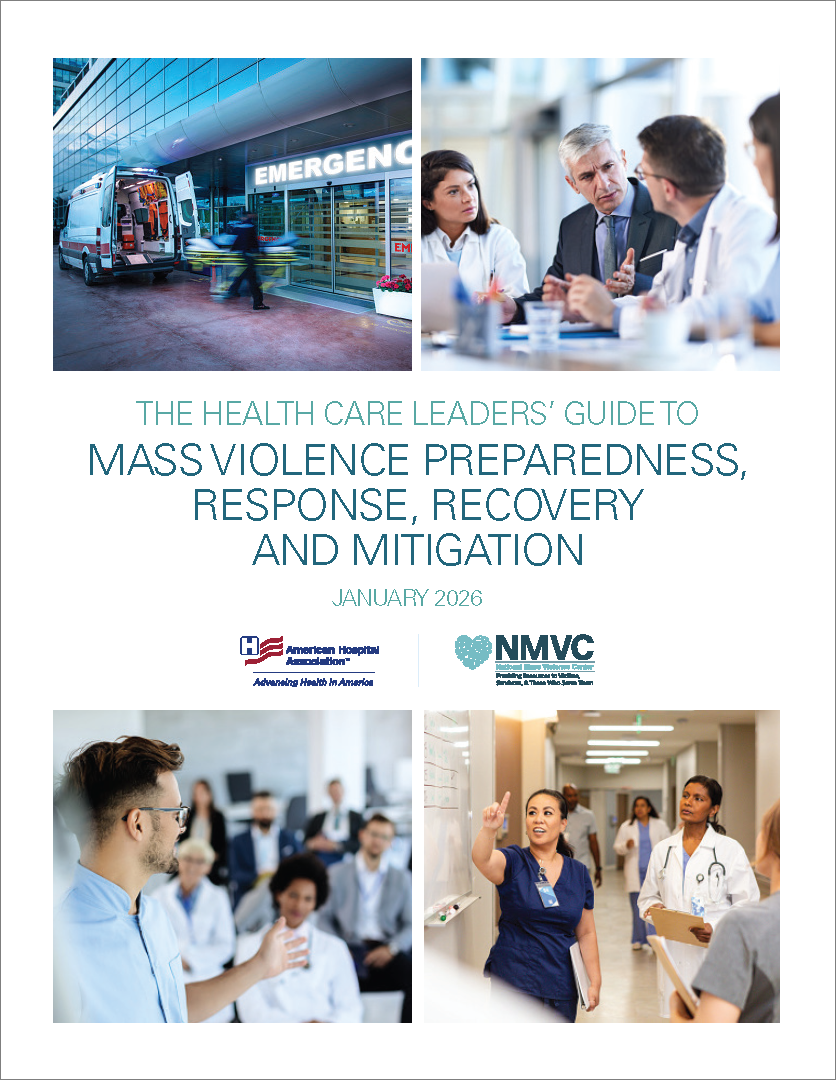
The Health Care Leaders’ Guide to Mass Violence Preparedness, Response, Recovery and Mitigation
Hospitals and health systems play a critical role in responding to mass violence incidents (MVIs), beginning with the initial crisis response and continuing through longer-term actions that address the physical, behavioral and mental health needs of MVI victims, survivors, first responders and their own workforce, as well as the collective health of the communities they serve.
By employing evidence-based approaches, hospitals can mitigate the impact of MVIs on victims, survivors, and their families. "The Health Care Leaders’ Guide to Mass Violence Preparedness, Response, Recovery and Mitigation," developed by the American Hospital Association and the National Mass Violence Center, offers evidence-based strategies that are easily incorporated into existing comprehensive emergency and disaster management plans, enabling hospitals to best respond to incidents stemming from violent crime. The recommendations offer specific guidance to prepare for and respond to MVIs and are provided to enhance — not replace — an organization’s existing emergency management plan.
Supplemental Resources
AHA News: HHS resource highlights lessons learned from mass violence events
AHA CEO Perspective: Stopping gun violence starts in the community
AHA CEO Perspective: Committing to care and preparedness
AHA News: El Paso hospital shares importance of training, preparedness in response to mass shooting
AHA News: When disaster strikes, hospitals are there
AHA Webinar: Understanding the Biopsychosocial Aspects of Violence Involving Firearms
AHA Podcast: Working together to prepare for emergency scenarios
Webinar Series: Supporting Victims and Communities of Mass Violence Incidents
General
- Virtual Resiliency Center
- National Town Halls
- Transcend NMVC Free Mobile App
- Mass Violence Podcast
- Overview of Three Centers: Friends & Relatives Center, Family
- Acronyms for Mass Violence Incidents: State and Local Levels
Preparedness
- Improving Community Preparedness Training and Technical Assistance (ICP TTA)
- NMVC’s The Role of Victim Assistance Professionals in Preparing for Mass Violence Incidents
- NMVC’s Master Acronym List for Victim Assistance Professionals
- Greater New York Hospital Association’s toolkit helps hospitals prepare for mass casualty incidents
- Crime Victim Compensation Tip Sheet
Response
- Planning and Implementation Guide for Comprehensive, Coordinated Victim Assistance for Mass Violence Incident Trials
- NMVC’s The Role of Victim Assistance Professionals in Responding to Mass Violence Incidents
- NMVVRC’s After a Mass Violence Incident: Helpful Websites and Social Media Account
Recovery
- NMVVRC Resource Page for Tulsa, Ok
- Managing Distress: Grounding Tips for Crime Victims, Survivors and Family Members of Mass Violence Incidents (MVIs)
- American Hospital Association Webinar Series: Ten Core Victims’ Rights
- 23 National Toll-free Information and Referral Resources for Crime Victim/Survivor Assistance
- NMVC’s The Role of Victim Assistance Professionals in Building Resilience after Mass Violence Incidents
- Research: Children's Mental Health in the Context of Terrorist Attacks, Ongoing Threats, and Possibilities of Future Terrorism.
- Research: Psychosocial interventions for children and adolescents after man-made and natural disasters: a meta-analysis and systematic review.
- Research: Caregiver distress, shared traumatic exposure, and child adjustment among area youth following the 2013 Boston Marathon bombing.
Mitigation
Related Resources
Toolkits/Methodology