

Closing the Information Gap between EMS and Hospital Care
New Trailblazers Report

The Challenge: EMS Data Often Arrives Too Late
When trauma patients arrive by ambulance, critical decisions often must be made within minutes. Yet for many hospitals, key information from emergency medical services (EMS) — including field assessments, vital signs and early interventions — does not reach clinicians until after treatment has already begun. This delay can complicate care decisions, slow documentation and weaken performance review.
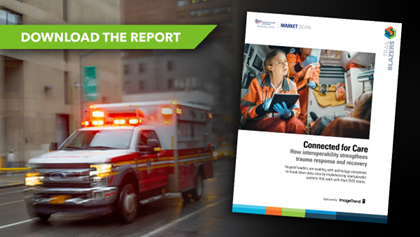
A new AHA Market Scan Trailblazer report, Connected for Care: How Interoperability Strengthens Trauma Response and Recovery, examines how hospitals and state agencies are addressing this challenge by improving interoperability between EMS electronic patient care reports (ePCRs) and hospital electronic health records (EHRs).
The report, sponsored by ImageTrend, highlights the scale of the problem. A statewide analysis in California found that fewer than half of EMS records successfully matched corresponding hospital trauma records, largely due to incompatible systems and inconsistent data formats. Similar gaps exist nationwide, limiting hospitals’ ability to access pre-hospital data at the point of care.
How Trailblazers Are Closing the EMS–Hospital Information Gap
Trailblazer organizations are closing these gaps by integrating EMS data directly into clinical and registry workflows. Hospitals that receive structured ePCR data electronically report earlier visibility into patient condition, more accurate event timelines and fewer missing data elements — all of which support faster clinical decision-making and reduce the administrative burden on clinicians and trauma registrars.
Leading organizations are addressing the problem in multiple ways. Some are advancing electronic integration, so ePCRs flow directly into hospital electronic health records. At Carilion Clinic in Roanoke, Virginia, automated delivery of EMS reports into the EHR eliminated scanning delays and gave emergency department teams access to field data while patients were still being treated. At the Mississippi State Department of Health, a modernized trauma registry enabled statewide integration of EMS and hospital data, improving oversight, reporting and preparation for verification reviews.
Other organizations are strengthening early response by pairing pre-arrival EMS notification with redesigned intake workflows. A study from Baylor University Medical Center in Dallas found that advance EMS notification helped stroke teams move patients to CT imaging and IV thrombolysis more quickly. At Good Samaritan University Hospital in West Islip, New York, leaders redesigned ambulance-bay intake so patients are assessed and registered immediately on arrival, cutting door-to-provider times by more than two-thirds and improving EMS turnaround — even when pre-arrival data exchange is limited.
Together, these examples underscore a key lesson from the Trailblazer report: Early EMS information is only as effective as the workflows designed to use it. By combining interoperable data exchange with operational readiness at the front door, hospitals can improve clinical decision-making, reduce administrative burden and strengthen trauma and emergency care performance.
Download the full report to explore how hospitals and public agencies are strengthening trauma response through interoperable data exchange and real-world implementation strategies.



Related Resources
Issue Landing Page
Guides and Reports
AHA Center for Health Innovation Market Scan