


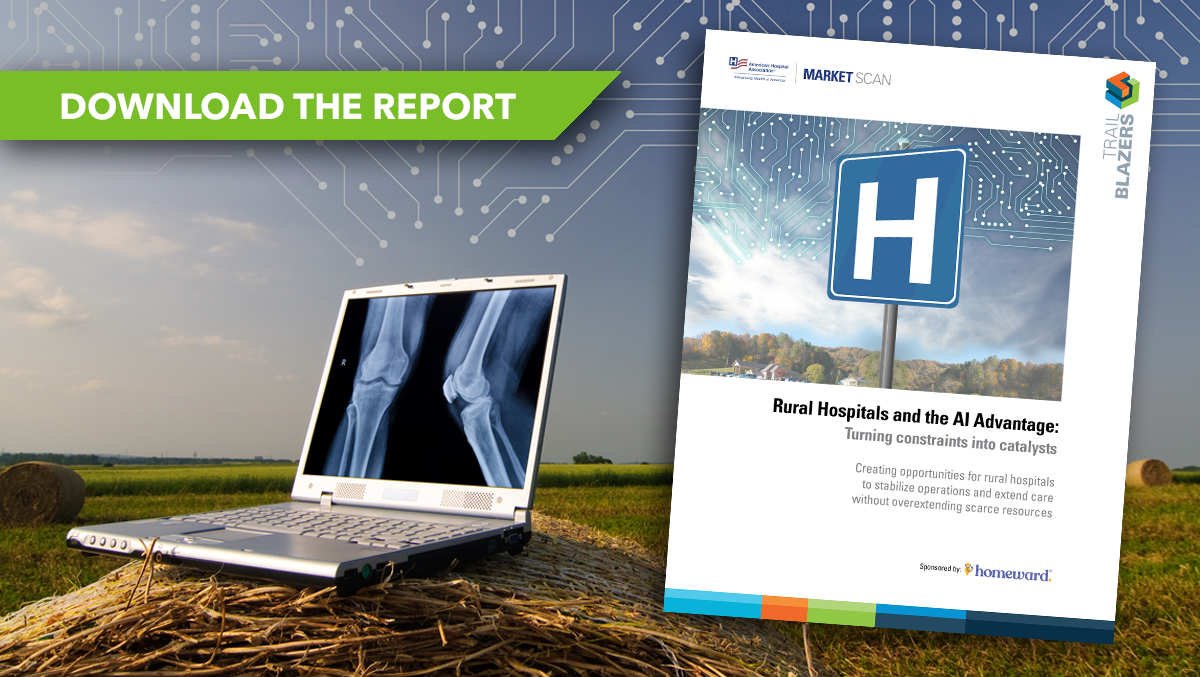
Rural Hospitals and the AI Advantage: Turning Constraints into Catalysts
Rural hospitals face some of the most acute pressures in health care today — from thin operating margins and workforce shortages to geographic isolation and growing administrative burden. Nearly half operate at a financial loss, and many are considered vulnerable to closure. Yet a new AHA Market Scan Trailblazer report suggests these constraints may also be accelerating a more pragmatic and targeted approach to artificial intelligence adoption.
Rather than pursuing large-scale digital transformation, rural hospitals are increasingly using AI as an operational enabler — starting where impact is immediate and investment requirements are modest. Early adoption often centers on revenue cycle automation, documentation support and analytics embedded directly into existing workflows. These tools help stabilize cash flow, reduce administrative drag and preserve scarce clinical capacity without requiring enterprise-wide system replacement.
Revenue cycle automation has emerged as a common entry point. With limited administrative staff and high sensitivity to delayed reimbursement, rural hospitals are applying AI to tasks such as claims review, denial management and coding — areas where automation can quickly reduce rework and improve turnaround times. Similarly, AI-powered ambient documentation tools are helping address workforce strain by reducing after-hours charting and allowing clinicians to spend more time focused on patients rather than screens.
The report, sponsored by Homeward Health, also highlights how AI-supported analytics and data activation can help rural hospitals better use information they already collect — supporting care coordination, quality measurement and timely follow-up without large analytics teams. As foundational capabilities such as interoperability and digital reporting mature, these tools are becoming more accessible to smaller organizations.
Case studies from Sanford Health and Central Montana Medical Center illustrate a consistent theme: AI adoption does not need to be disruptive to be transformative. By prioritizing clinician input, focusing on real-world workflows and validating value at each step, rural hospitals are using AI to reduce burnout, extend access and strengthen operational resilience.
As the report concludes, AI is becoming less a futuristic concept and more essential infrastructure — helping rural hospitals sustain care, trust and access in the communities that depend on them most.
Download the full report to explore how rural hospitals are using targeted AI applications — across revenue cycle operations, clinical documentation, analytics and virtual care — to reduce administrative burden, support workforce sustainability and extend access to care without large-scale technology overhauls.



Related Resources
Toolkits/Methodology
AHA Center for Health Innovation Market Scan