

5 Practices Behind Sustained Organizational Success
When Rick Anderson first enrolled in graduate school at the University of Pittsburgh School of Public Health, he had no prior healthcare experience. “The dean told me I was an experiment,” he recalled.
However, his advisors at the University of Illinois, where he completed his undergraduate studies in 1969, recommended that he pursue a career in healthcare, an up-and-coming field at the time.
“Based on my personality, they thought I would be a good leader, so they said, ‘You should look at some of these graduate schools,’” Anderson said.
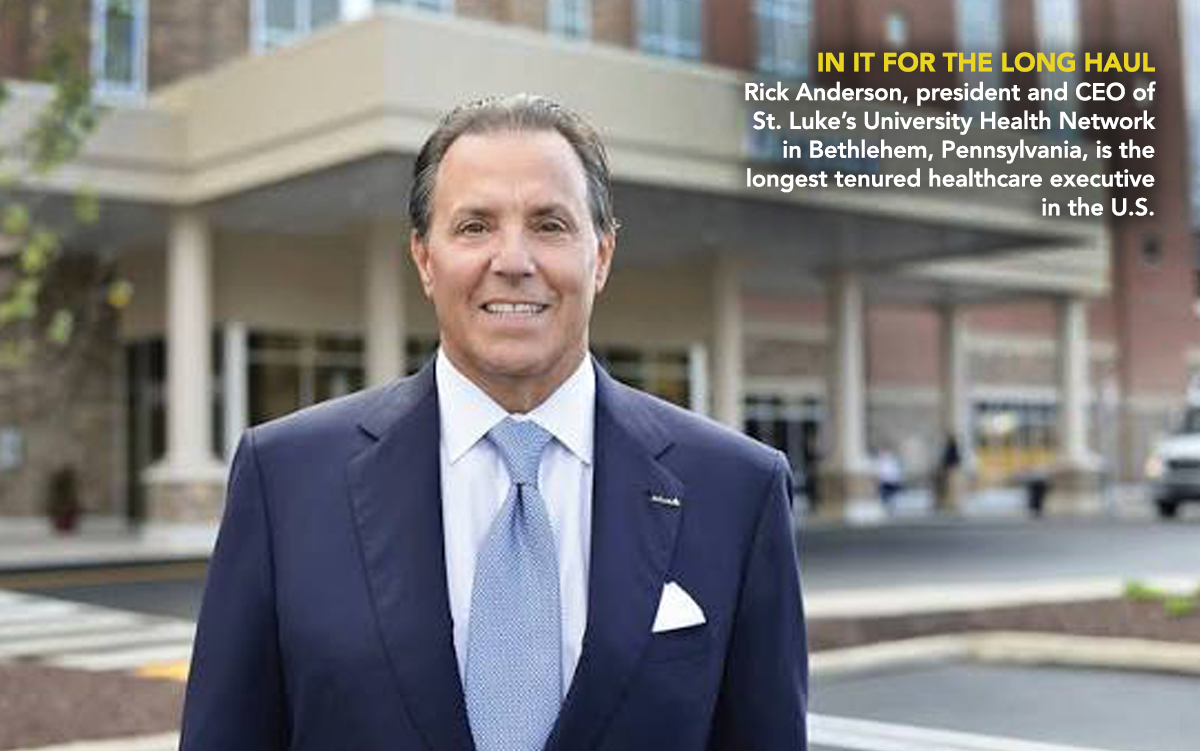
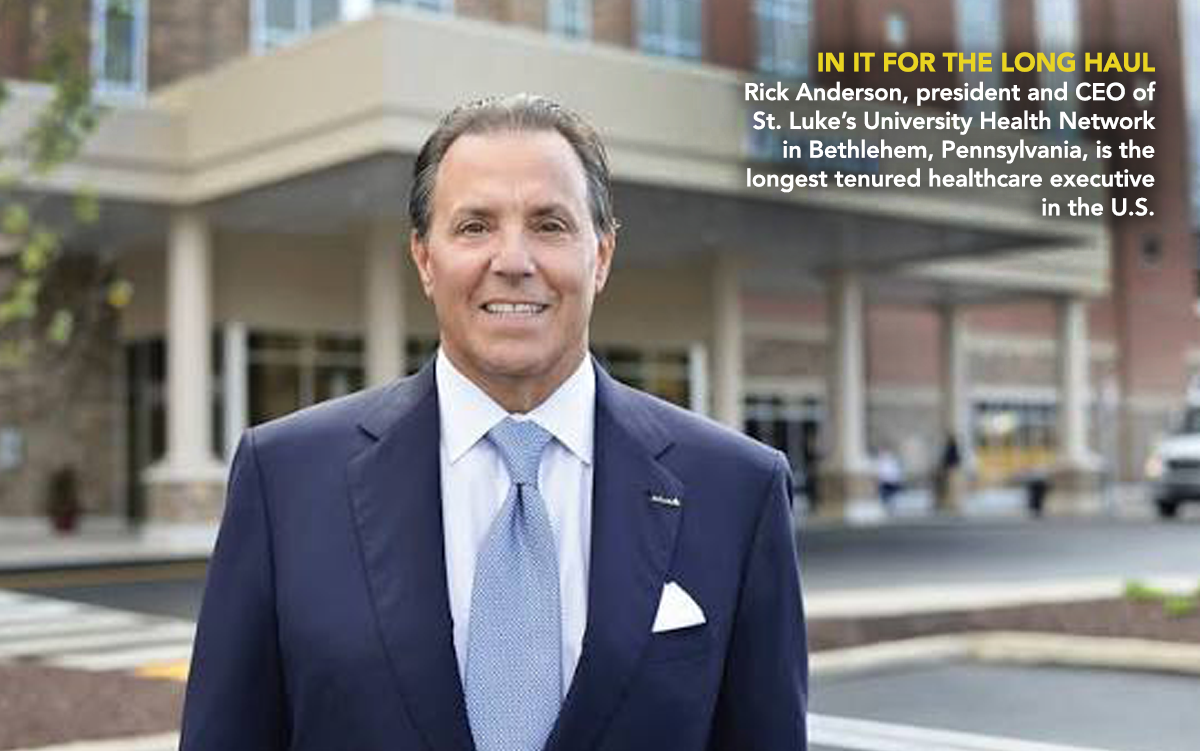
Those advisors — who had noticed potential in Anderson’s honesty and skill in engaging people — were on to something. After graduating from the University of Pittsburgh in 1971 with a master’s degree in public health in healthcare administration, he went on to become president and CEO of St. Luke’s University Health Network in Bethlehem, Pennsylvania. Today, Anderson is the longest-tenured healthcare executive in the U.S., with 41 years and counting in his position overseeing St. Luke’s, according to Lehigh Valley Press.
When he stepped up to lead St. Luke’s in 1985, it consisted of a single hospital in Bethlehem. With Anderson at the helm, the not-for-profit health system has expanded to include 16 hospital campuses and more than 350 outpatient treatment locations across 11 counties in Pennsylvania and New Jersey. Under Anderson’s oversight, St. Luke’s has been recognized as a top place to work by publications like The Morning Call, USA Today and NJ.com. It has also earned numerous awards for high-quality care. In 2025, in a study by the U.S. Department of Health and Human Services, St. Luke’s received the highest quality score of the nation's three highest performing health systems.
In a recent interview with the American Hospital Association, Anderson offered insights into how he and his team transformed one hospital into one of the country’s top-performing health systems and reflected on his tenure in a field where executives face significant pressure and strong headwinds. Here are a few key insights he shared for other healthcare leaders seeking to cultivate endurance and resilience in a complex and challenging environment.
1 | Stay focused on the patients above all else.
During the decades Anderson has led St. Luke’s, the healthcare field has changed dramatically, particularly in technology. However, he notes that one constant endures. “Your focus needs to be on taking care of your patients,” he said.
Anderson recommends treating your patients as you would your own loved ones: “You have to ask, is that what you would want for your mom, your dad, your loved ones, your children?”
Delivering that level of high-quality, patient-centered care starts with a dedicated team and a culture that makes them eager to show up. St. Luke’s routinely solicits feedback from employees and fosters strong relationships between leaders and staff to prevent burnout and minimize turnover. Anderson emphasizes that the credit for the health system's success over the years rests with the entire team, of which he is one member.
“Nothing gets done in healthcare because of one person,” he said. “Everybody we have is essential to getting the job done. People will say, ‘Oh, Rick, you're running such a great place.’ No, it's everybody here, working together, taking care of that patient, trusting one another.”
2 | Honesty and trust are the foundation of effective leadership.
Anderson’s effectiveness as a leader boils down to the qualities that made him stand out to his undergraduate advisors: Honesty, transparency and integrity. He doesn’t get things done by throwing his weight around as the CEO; rather, he’s accomplished so much by building strong relationships with his team and establishing trust.
“It's how you talk to people,” he explained. “If you show respect and if they trust that you'll be honest with them, those are some of the important characteristics you have to have as a leader.”
His approach helped him break down silos and turn St. Luke’s into an integrated health system, with care coordinated across service lines. Clear, direct communication has served as the foundation for cooperation across the organization.
“Treat people with respect, try to do the right thing all the time, and be transparent with people,” Anderson said. “That's what you learn with a lot of years of living.”
3 | Invest in education and internal talent pipelines.
St. Luke’s isn’t concerned about workforce shortages. The health system has consistently invested in local talent pipelines. Nearly 17 years ago, under Anderson’s leadership, St. Luke’s launched the Lehigh Valley’s sole regional medical school campus through a partnership with the Lewis Katz School of Medicine at Temple University. Since 2010, Anderson estimates that the medical school has graduated approximately 400 doctors, and about 75% of them stay in the area to pursue their careers.
The provider also runs the nation’s oldest nursing school in continuous operation, established in 1884. Anderson notes that he faced pressure to shut down the nursing school in the 1980s to reduce spending, but he resisted, a wise decision in light of the current nursing shortage.
In addition, the newly launched St. Luke’s College of Health Sciences welcomed its inaugural class in May 2026.
“Training them keeps the community healthy and keeps our hospitals healthy and viable,” Anderson said of the students and investments in education. “It all works together.”
4 | Never stop fine-tuning your approach and embrace change.
Like a television set, Anderson explains, a health system requires routine fine-tuning to operate properly. Those adjustments include adopting new technology, equipment and care delivery methods as they emerge.
“We fine-tune a lot here,” he said of St. Luke’s. “What has really changed is the technology and the testing and the equipment we have, the CT scans, the MRIs and the PET scans.”
Anderson has witnessed various adjustments and advancements in treatment, including robotic surgery, Transcatheter Aortic Valve Replacements and the WATCHMAN procedure, a minimally invasive intervention that reduces the risk of stroke for patients with atrial fibrillation.
“You name it, and it changes,” he said. “And you just have to be ready to change.”
For instance, one significant way St. Luke’s is changing is by investing in genomics. The health system has launched DNA Answers, a community health research program that facilitates no-cost genetic testing to support precision medicine and preventive care.
“We've just scratched the surface with genomics,” Anderson said. “That's going to be a really big deal, that we'll know about our DNA and when we can expect chronic diseases to develop.”
5 | Keep searching for solutions and be open to new ideas.
For Anderson, his work is never finished, and he enjoys taking on new projects and solving problems. “There's always a challenge every day,” he said. “There's something to do. There's something to fix. There's something to make better.”
Anderson prefers to frame problems as opportunities. He also advises other healthcare leaders to be patient with their team members and to let them know it’s okay to make mistakes, as long as they’re learning from them.
At the end of the day, a truly effective healthcare executive’s education is never over, according to Anderson. He attributes his long tenure to resisting resting on his laurels and showing up day after day, ready to continue learning, fixing and finding solutions — a pragmatic outlook he credits to his blue-collar origins.
“Leadership is not something you learn in school or a book,” he said. “It’s a lifelong pursuit. There’s always an opportunity to improve your leadership or to fix something in the organization.”



Related Resources
AHA Center for Health Innovation Market Scan